The palate is the roof of the mouth and the floor of the nose at the same time. When cancer takes part of it away, reconstruction rebuilds that partition so speech, drinking and eating work properly again.
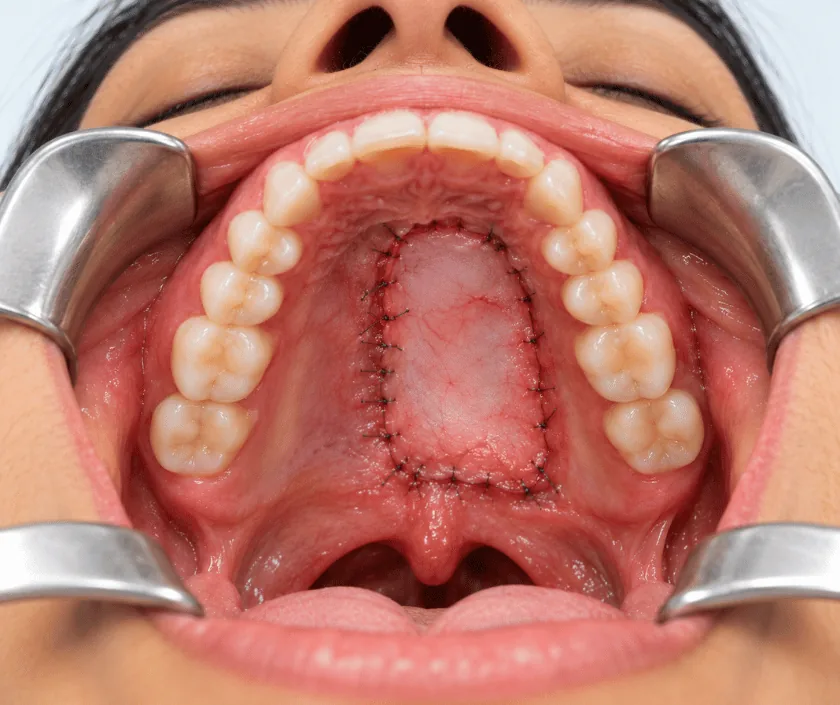
Palate reconstruction closes the opening left between the mouth and the nose after a cancer has been removed from the roof of the mouth. Small defects may be covered with a local flap of nearby tissue or managed with a dental plate. Larger ones usually need a free flap, so that air, food and liquid stay in the mouth where they belong.
The palate does two jobs at once. Its lower surface is the roof of the mouth, and its upper surface is the floor of the nose. Cancer here is usually removed with the lining and a portion of the bone underneath, which leaves a direct opening into the nasal cavity. Patients notice it immediately, because water taken by mouth comes back down the nose.
There are two broad ways to deal with that opening. One is an obturator, a custom dental plate that plugs the defect and can be taken out for cleaning and for inspecting the area. The other is surgical reconstruction, in which tissue is brought in to close the partition and stay in place. Local flaps from the cheek or the remaining palate handle smaller defects. Bigger ones, or those extending into the upper jaw, generally need a free flap whose vessels are joined to vessels in the neck.
The choice is made together with the cancer surgeon and the dental team. Position of the defect, how much bone was removed, whether radiotherapy is planned and how easily you can attend for plate adjustments all feed into the decision.
Not every palate defect needs surgery, so the first question is whether a plate or a flap serves you better. That is settled with the cancer and dental teams together.
The cancer surgeon, the reconstructive surgeon and the dental team review the scans together. The defect is mapped, and the merits of an obturator against a flap are discussed openly with you.
The cancer is taken out with a margin of healthy tissue, which often includes palate bone. The exact size of the resulting opening becomes clear only at this stage.
A local flap from the palate or cheek may be turned over for a small defect. Larger openings take a free flap raised from the forearm or the thigh with its vessels attached.
Tissue is inset in two layers where possible, one facing the nose and one facing the mouth. Vessels are joined under a microscope whenever a free flap is used.
A temporary plate may be fitted to protect the repair while healing begins. Feeding is by tube for a short period so the closure is not stressed by chewing.
Swelling is at its peak and feeding goes through a tube. Any plate stays in place as instructed. The repair is checked daily and the mouth is rinsed gently.
Swelling reduces and liquids by mouth usually begin once the closure is judged secure. Speech is tested and often already sounds less nasal than before surgery.
Most healing is complete and soft solids are usually tolerated. Radiotherapy, if planned, tends to begin around this time. Speech therapy continues where sounds remain unclear.
The reconstruction has settled and the diet has widened for most patients. Dental rehabilitation is considered from this point. Cancer surveillance visits carry on as scheduled.
Sealing the opening usually gives an immediate improvement in drinking, and speech tends to sound clearer within weeks. Even so, the reconstructed palate is a fixed surface rather than a moving one, so certain sounds may stay slightly altered. Sensation over the repair is reduced. If the soft palate was removed, speech and swallowing results are harder to predict and depend heavily on therapy. Most people gain comfortable eating and clear enough speech.
The repair sits between two very different environments, the mouth and the nose, which shapes the risks it carries.
Protecting the repair through the first few weeks is what most of the home routine is about.
An opening between mouth and nose does not heal shut by itself. It needs either a plate to seal it or tissue brought in to close it.
A plate suits some defects very well, yet it needs regular adjustment, careful cleaning and enough teeth or bone to grip.
Sealing the defect usually improves speech noticeably, and therapy helps further with the sounds that stay unclear.
Radiotherapy usually begins once wounds have healed, and this timing is planned with the oncology team from the outset.
Elegance Clinic in Surat plans palate repair with the dental and cancer teams together, so the choice between a plate and a flap is made for your situation rather than by habit. Families receive the plan and the estimate before admission.

The final figure depends on whether a local flap or a free flap is used, how long the operation runs, and how many days you spend in hospital. Dental work such as an obturator is costed separately by the dental team.
You are given a written estimate once the plan is agreed. Insurance policies and government schemes often cover cancer surgery, so bring your documents to the consultation.
These are the questions that come up most often in consultation. If yours is not here, send it on WhatsApp and the team will reply, usually the same day.
Ask your question →Free flap reconstruction generally falls in the band of Rs 1.8L to Rs 4.5L. Local flap repairs cost less. The figure moves with operating time, hospital stay and whether the upper jaw is involved, and a written estimate is given before admission.
For some defects a well made plate seals the opening comfortably and avoids a long operation. It does need regular adjustment, careful cleaning and enough remaining teeth or bone to grip. Both options are compared for your particular defect.
Feeding usually goes through a tube for the first few days while the repair settles. Liquids by mouth generally begin once the closure is judged secure, often in the second week. Soft solids follow, then a wider diet over the next few weeks.
Speech usually becomes noticeably clearer once air stops escaping into the nose. Some sounds may remain slightly altered, particularly if part of the soft palate was removed. Therapy helps, and improvement often continues over several months.
Yes, although treated tissue heals more slowly and the chance of a small leak is higher. Flaps with their own blood supply are usually preferred in that setting, since they bring healthy tissue from outside the treated area.
Closing at the same sitting as the cancer removal is common, because healthy tissue is available and treatment is not delayed. Sometimes a temporary plate is used first and reconstruction planned later, once the pathology report is complete.
The mouth and the defect are examined, scans and reports are reviewed, and both closure options are explained. Speech, eating and dental plans are discussed with the family, and a written estimate follows once the approach is agreed.
Each technique below has its own page explaining how it works and when it is chosen.
Seeing patients from across the city and beyond: read about the practice on the plastic surgeon in Surat page, or check what a written estimate covers on the costs and insurance page.
