The pharynx is the muscular tube at the back of the throat that carries every mouthful down towards the food pipe. When cancer takes part of it, reconstruction rebuilds a continuous passage so swallowing becomes possible again.
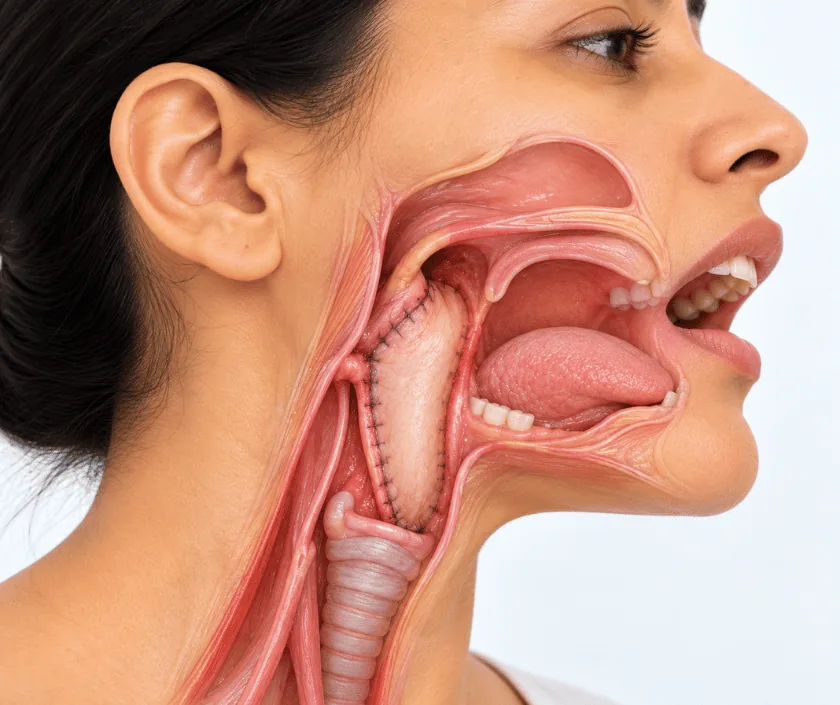
Pharyngeal reconstruction rebuilds the throat passage after cancer surgery has removed part or all of it. A patch of tissue may be enough when only one wall is missing, while a complete removal needs a full tube, made either from a rolled skin flap or from a segment of small intestine. The purpose is safe swallowing and, where possible, voice.
Behind the tongue and the voice box lies a muscular funnel that every swallow passes through. Cancer here often needs removal of the voice box along with part or all of that funnel, which leaves either a gap in one wall or no passage at all. Without reconstruction, food and saliva have nowhere to go.
Repairs fall into two broad groups. When part of the wall remains, a flat patch of tissue can be sewn in to widen the passage, commonly taken from the forearm or the thigh. When the whole circumference has been removed, a complete tube is required. That tube may be made by rolling a skin flap into a cylinder, or by transferring a short segment of small intestine with its own artery and vein, joined to vessels in the neck under a microscope.
Voice is planned at the same time. When the voice box has been removed, a small valve may be placed between the windpipe and the new passage to allow speech, or other methods are taught by the speech therapist. Nutrition, dental care and radiotherapy timing are all arranged alongside.
This is a long operation on a patient who is often already unwell, so fitness and nutrition are assessed carefully before anything is scheduled.
Scans, endoscopy findings and nutrition are reviewed with the cancer team. A feeding tube may be started beforehand. Chest fitness, dental status and voice options are all discussed with you.
The voice box and the involved throat lining are removed, and neck glands are cleared. An opening is created in the neck for breathing when the voice box has been taken.
A second team prepares the reconstruction, either a flat flap from the forearm or thigh, or a short segment of small intestine taken through a separate abdominal incision.
The tissue is patched in or rolled into a tube and stitched to the throat above and the food pipe below. Vessels are joined under a microscope and blood flow is confirmed.
A valve for speech may be placed during the same operation or later. Feeding continues through a tube until a swallow study shows the new passage is watertight.
Care continues in a monitored bed. The flap is checked regularly and the neck opening is suctioned and humidified. Feeding is by tube and communication is written rather than spoken.
Drains come out as leakage settles. Neck opening care is taught to you and the family. A swallow study is usually done towards the end of this period before sips are allowed.
Swallowing has usually progressed to soft food. Radiotherapy, when advised, tends to begin around now. Voice work with the speech therapist is well underway.
Diet has widened for most patients and voice has become more reliable. Any narrowing of the passage is treated as it appears. Cancer surveillance continues under the oncology team.
Most people regain the ability to swallow, though the passage is a rebuilt tube rather than a working muscular funnel, so eating tends to be slower and drier foods can stick. Sips of liquid alongside meals usually help. Voice, when the voice box has been removed, is produced by a valve or another method and sounds different from before. Progress continues over many months with therapy support.
This is among the larger operations in head and neck surgery, and the risks reflect that honestly.
Home care covers the neck opening, feeding and voice practice, and the family is taught each part before discharge.
Speech is usually regained through a valve, an electronic device or a learned technique. It sounds different, yet conversation is possible for most people.
The tube supports you while the join heals and is usually removed once a swallow study confirms the new passage is watertight.
Radiotherapy is the right choice for some throat cancers and not for others. The decision rests on stage, site and previous treatment, taken by the cancer team.
Swallowing usually becomes comfortable, but the rebuilt passage does not squeeze like natural muscle, so meals are often slower and drier food needs liquid alongside.
Elegance Clinic in Surat treats throat reconstruction as a plan that runs from nutrition before surgery to voice therapy months afterwards. Families are shown what daily care will involve before admission rather than at discharge.

The figure depends on whether a patch or a full tube is needed, whether intestine is used, the hours in theatre and the length of stay in a monitored bed. Cases operated after previous radiotherapy usually need longer care.
An itemised written estimate is given once the plan is agreed with the cancer team. Insurance and government schemes frequently cover this surgery, so bring your papers along.
These are the questions that come up most often in consultation. If yours is not here, send it on WhatsApp and the team will reply, usually the same day.
Ask your question →Free flap reconstruction generally falls between Rs 1.8L and Rs 4.5L. A full tube reconstruction, especially using intestine, sits at the higher end because theatre time and hospital stay are longer. A written estimate is given before admission.
When the voice box is removed, speech is regained using a valve placed between the windpipe and the new passage, an electronic device held against the neck, or a learned technique. It sounds different, and a speech therapist guides the process.
Feeding goes through a tube at first. A swallow study is usually done around the second week, and sips begin once the join is shown to be watertight. Soft food follows, with the diet widening over the weeks afterwards.
It is done regularly in that situation, though healing is slower and leaks are more likely because treated tissue has a poorer blood supply. Flaps bring in healthy tissue from outside the treated field, which is why they are preferred.
Fitness is assessed carefully beforehand, covering heart, lungs, nutrition and blood sugar. Where nutrition is poor, feeding support is started first. If a long operation is unsafe, alternative approaches are discussed openly.
Surgery is arranged once staging is complete and nutrition and chest problems have been addressed. Radiotherapy, where advised, typically follows about six weeks later, with the exact timing decided by the oncology team.
Endoscopy findings, scans and nutrition are reviewed, and the neck is examined. The removal, the type of reconstruction, breathing through a neck opening and voice options are explained to you and the family, followed by a written estimate.
Each technique below has its own page explaining how it works and when it is chosen.
Seeing patients from across the city and beyond: read about the practice on the plastic surgeon in Surat page, or check what a written estimate covers on the costs and insurance page.
