A constricted ear has a tight rim, so the upper part folds down and the ear looks smaller than its partner. This page explains the range of shapes, when moulding may help, what surgery does and what it may cost.
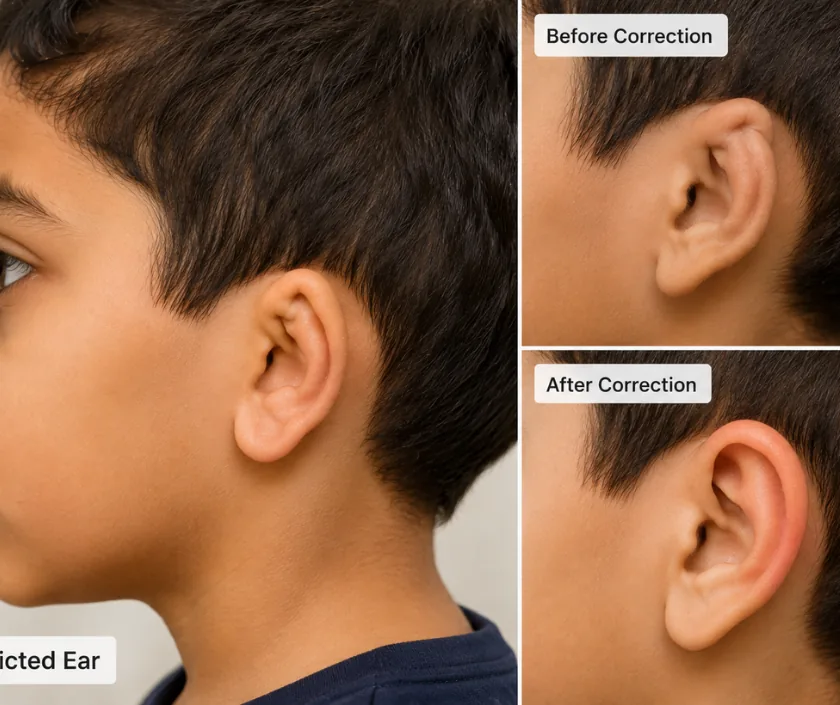
A constricted ear, sometimes called a lop ear, has a tight rim that pulls the upper part of the ear down or over. Shapes range from a slightly folded rim to an ear that is clearly small. Mild forms in the first weeks of life often respond to moulding with a soft splint. Firmer shapes need surgery to release the rim and rebuild the missing curve.
The rim of the ear starts as a flat plate that curls into shape before birth. When that curling is incomplete, the rim stays tight and behaves like a drawstring. It pulls the top of the ear downwards, so the ear looks folded over, shorter than the other side, and often stands outwards as well.
Shapes vary a great deal. At the mild end only the upper rim is turned over and the ear is close to full height. Further along the range, the whole upper third folds down and the hollow above the bowl is flattened. At the firm end the ear is small and cupped, and there is a genuine shortage of skin and cartilage rather than just a fold in the wrong place.
Hearing is normal in most children, because the canal and the inner ear form separately. The concerns are usually appearance, difficulty keeping spectacles on that side, and later self consciousness. Where a baby is only a few weeks old, moulding may improve the shape without any operation.
Newborn moulding and surgery are two different routes, and which one applies depends mostly on the age of the child when we first see the ear.
The ear is measured against the other side and the tight rim is examined. How much cartilage and skin are actually missing decides whether a release alone will do or extra cartilage is needed.
For babies seen in the first weeks, a soft splint is fitted and worn steadily for some weeks. Skin is checked regularly. Many mild shapes improve well and never need an operation.
Older children sleep under a general anaesthetic and adults may have local anaesthesia. Cuts are placed behind the ear and along the rim so that scars are as hidden as possible.
The tight band of cartilage is freed and the folded upper ear is unrolled and held open with fine stitches. This alone restores height when the shortage of tissue is small.
When the ear is genuinely small, a piece of cartilage may be borrowed from the ear bowl or the rib to lengthen the rim, and skin behind the ear is used to cover it.
A firm dressing supports the new shape and the head is kept raised. Aching is normal and settles with simple pain relief. Severe pain on one side should be reported the same day.
The dressing comes off in clinic and the ear looks swollen and bruised. Most children return to school in about a week. A soft headband is worn at night to protect the shape.
Swelling has largely settled and the height gained is easier to judge. Sport and swimming usually restart once the surgeon has checked that healing is complete.
Scars soften and fade over months. Any small remaining fold is reviewed now, and a second smaller procedure is sometimes suggested to refine the rim.
A constricted ear usually ends up taller and more open, with a rim that follows a natural curve. It will not become an exact copy of the other ear, and a slight difference in size or angle is usual. Scars sit behind the ear or along natural lines and fade slowly. Cartilage has a memory, so a small part of the old fold can return and a further small procedure is sometimes needed.
Correcting a constricted ear is careful, detailed work on a small structure. Results are usually pleasing, and it still helps to know what can go wrong.
A head dressing protects the ear at first, and the ear then needs guarding from knocks for several weeks.
Moulding works only while newborn cartilage is soft, which is a matter of weeks. Later on, tape does not reshape it.
The outer shape and the hearing parts are separate, and hearing is usually normal. It is still checked.
A fold present at birth tends to stay. Ears get bigger as a child grows, but the rim does not straighten itself.
Even the ears a person is born with are not a matched pair. The aim is an ear that draws no attention.
Families come to us for an early opinion, because in the first weeks of life a splint can achieve what would otherwise need surgery later.

Price depends on how tight the rim is, whether one ear or both are treated, the type of anaesthesia and whether extra cartilage has to be taken to lengthen the ear. A simple release costs less than a reconstruction that borrows cartilage from the rib. Because these shapes vary so widely, a written estimate is prepared only after the ear is examined, and insurance cover is checked at the same visit.
These are the questions that come up most often in consultation. If yours is not here, send it on WhatsApp and the team will reply, usually the same day.
Ask your question →A written estimate follows examination, because the work needed varies so much. A simple release of the rim costs less than a reconstruction that borrows cartilage. Anaesthesia, one ear or two, and hospital time all affect the figure, which is given to you in writing.
In the first weeks of life the cartilage is soft and a moulding splint can improve many mild shapes. It is worn steadily for some weeks and the skin is checked often. Firm ears with a real shortage of tissue still need surgery later.
Surgery is usually planned from about school age, once the ear is close to adult size and the child can share in the decision. Earlier surgery is considered when the shape is marked. Growth, not a fixed birthday, guides the timing.
This is day case surgery in most children, with a general anaesthetic given by a team used to young patients. Bleeding, infection and partial return of the fold are the main risks. Health is checked before the date, and problems are uncommon.
A dressing stays on for a few days, then a soft headband is used at night for some weeks. School usually restarts in about a week. Sport and swimming wait around six weeks, and swelling keeps settling for a few months.
The aim is an ear that is close in height, shape and position and looks natural from the front. A close match is realistic. Small differences in size or the line of the rim often remain and are rarely noticed by others.
The ear is examined and measured against the other side and photographs are taken. You will hear which shapes respond to moulding, what surgery could achieve at your child's age, the recovery involved and the written estimate before booking.
Seeing patients from across the city and beyond: read about the practice on the plastic surgeon in Surat page, or check what a written estimate covers on the costs and insurance page.
