A cleft often leaves the nose flat, twisted or blocked even after the lip has healed well. This page explains how secondary cleft nose correction is planned in Surat, what the surgery can change and what it usually costs.
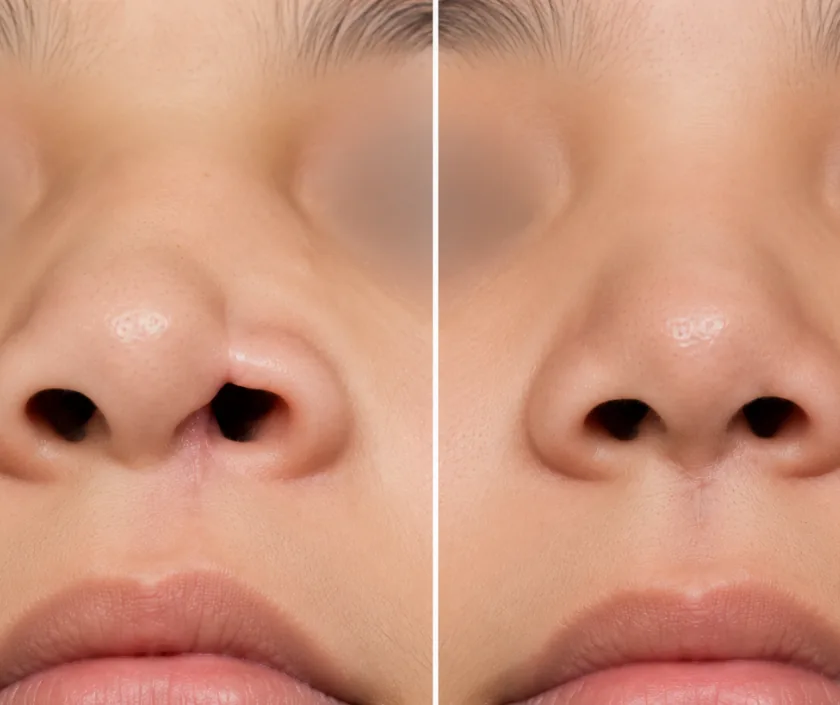
Secondary cleft nose correction reshapes a nose left flat, twisted or narrow by a cleft. Surgeons straighten the septum, lift and reposition the lower cartilages and often add cartilage grafts to support the tip and the nostril rim. Most teams prefer to wait until facial growth is well advanced, though an earlier limited correction is sometimes offered.
A cleft affects the nose as well as the lip. Cartilage on the cleft side is flattened and pushed sideways, the nostril is wide and low, and the wall between the nostrils leans away from the middle. Breathing through that side is often poor, which parents notice long before they mind the shape.
Correction is a form of rhinoplasty built around scarred, uneven tissue rather than a normal nose. Through an incision across the base of the nose the skin is lifted, so the cartilages can be seen and released from their wrong position. Grafts of cartilage, usually taken from the septum, the ear or a rib, are then used to hold the new shape and to support the rim.
Timing is a real decision. Waiting until growth is well advanced gives a steadier long term result, while an earlier limited correction can help a child who is teased or who cannot breathe through one side. Both approaches are used, and the choice is made with the family.
This operation suits a child or young person whose cleft lip repair has healed but whose nose remains uneven in shape or blocked on one side. Timing depends on growth and on how much the nose troubles them.
Both sides of the nose are examined for blockage as well as appearance. Old scars, previous grafts and the position of the septum are noted, and photographs are taken from set angles.
The surgeon decides where support will come from. Septal cartilage is used when enough remains, otherwise cartilage is taken from behind the ear or, in larger corrections, from a rib.
A small incision across the base of the nose lets the skin be lifted. Cartilages held in the wrong position by scar are freed, which is often the step that changes the shape most.
The septum is straightened to open the airway. Cartilage grafts are then stitched in to lift the tip, hold the nostril rim and even out the base of the nose.
Fine stitches close the skin and an external splint holds the new shape. Soft internal supports are sometimes used, and both are removed at a planned clinic visit.
The splint stays on and the nose feels blocked. Swelling and bruising around the eyes are usual. Rest with the head raised helps, and blowing the nose is avoided completely.
The splint and stitches come off and bruising clears. Desk work or school restarts in this period. Glasses, contact sport and swimming are kept aside on advice.
Most of the visible swelling has gone and breathing usually feels clearer. The tip stays firm for longer, which is normal after grafting.
The final shape shows itself slowly across a year or more. A small refinement is sometimes discussed once everything has settled fully.
Swelling in the tip settles slowly and the final shape is not clear for a year or more. Scarring inside a cleft nose pulls tissue in ways an untouched nose does not, so the two nostrils rarely become identical. Cartilage that has been reshaped tends to drift a little back towards its old position over the years. Breathing usually improves when the septum is corrected. Many young people are pleased with a clear improvement rather than an exact match.
Operating on a cleft nose is harder than a standard rhinoplasty, because tissue is scarred and support is missing. A frank talk about limits belongs at the start rather than afterwards.
The first two weeks are about protecting the nose and keeping it clean. The months after are about patience while swelling settles.
Early shaping helps, but the nose keeps growing and many children benefit from a further correction in the teenage years.
A cleft nose has scar tissue, missing support and a leaning septum, so the planning and the surgery are different.
A clear improvement in symmetry is realistic. An exact match between the two sides is not.
Blockage is often quiet and shows up as mouth breathing or snoring rather than as an obvious complaint.
Cleft nose work sits at the meeting point of breathing, shape and growth, so we plan it against the whole treatment path rather than on its own.

The published band is wide because the work varies so much. A limited tip correction sits at the lower end, while a full correction using rib cartilage, septal straightening and lip revision at the same sitting sits at the upper end. Anaesthetic time, graft source and hospital stay all count. Cover is judged case by case, since function and appearance are often both involved. A written estimate follows examination.
These are the questions that come up most often in consultation. If yours is not here, send it on WhatsApp and the team will reply, usually the same day.
Ask your question →The published band runs from about Rs 85,000 to Rs 1.6L. A limited tip correction sits near the lower end, while a full correction using rib cartilage sits higher. Cover is judged case by case, so bring policy papers to the consultation.
Cleft rhinoplasty is planned work done under general anaesthesia by a team used to scarred noses. Fitness is checked first. Bleeding, infection, graft problems and a shape that shifts slightly are the main risks, and each is explained in plain words before consent.
A splint stays on for about a week and bruising clears over two to three weeks. Desk work or school usually restarts in the second week. Contact sport waits several weeks, and the fine shape keeps changing for a year.
Most patients gain a straighter, better supported nose and easier breathing on the blocked side. Matching the two sides exactly is not the aim, since the tissue differs from birth. Photographs taken before surgery help judge the change fairly at review.
Definitive correction is usually planned once facial growth is well advanced, in the mid to late teens. An earlier limited correction can be offered when a child cannot breathe through one side or is distressed by the shape. Growth guides the decision.
No. Nose correction is planned work, and there is time to think it over. Breathing that is badly blocked deserves earlier review, because it affects sleep and daily comfort. Booking an assessment early simply keeps the timing options open.
Both nostrils are examined for blockage, the septum is checked and the shape is studied from set angles. Photographs are taken and previous operation notes are reviewed. You will hear which changes are realistic, where grafts would come from and the written estimate.
Seeing patients from across the city and beyond: read about the practice on the plastic surgeon in Surat page, or check what a written estimate covers on the costs and insurance page.
