Fingers do the detailed work of the hand, so losing length or movement in one is felt every single day. Reconstruction aims to give back a finger that is stable, long enough to be useful and able to feel what it touches.
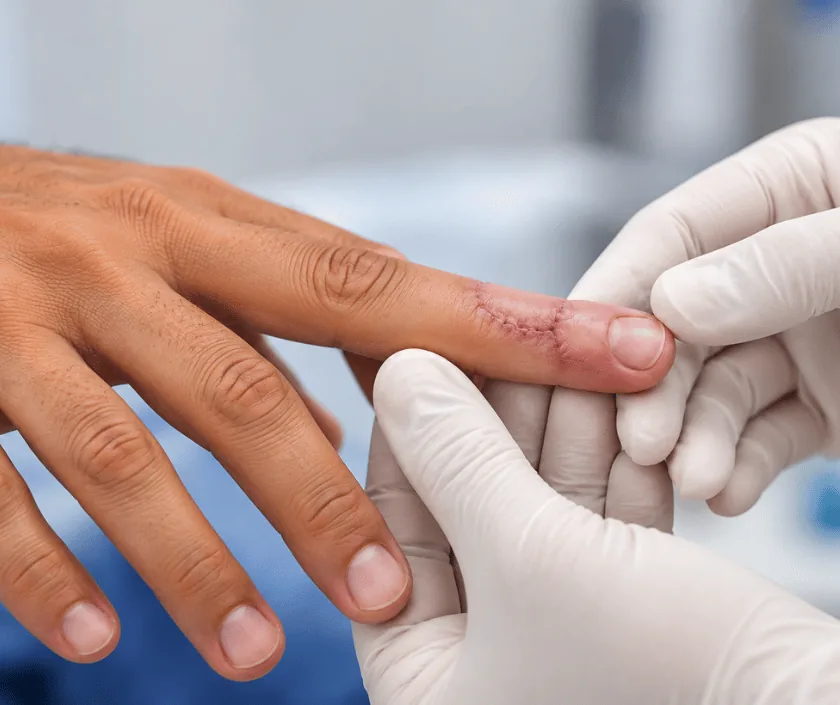
Finger reconstruction rebuilds bone, tendon, nerve or skin after an injury has left a finger short, stiff, unstable or numb. Depending on what is missing, surgeons use bone graft, tendon repair or grafting, nerve repair, skin grafts and local flaps. The goal is a finger that helps the hand rather than getting in its way.
Fingers work as a set. Each one contributes length, a gripping surface and feeling, and the hand quietly adjusts around whichever finger is weakest. After a serious injury a finger may be short, bent, numb or too painful to use, and the rest of the hand starts to avoid it.
Reconstruction begins by working out exactly what is missing. Bone may need graft or fixation to hold length. Tendons that were cut or scarred can be repaired, grafted, or reconstructed in stages using a silicone rod first. Divided nerves are joined directly or bridged with a graft so that protective feeling returns. Skin loss over a joint or tendon usually needs a flap rather than a graft, since a graft will not take on bare tendon or bone.
Sometimes the honest answer is that a shorter, comfortable finger serves the hand better than a long stiff one. That conversation happens openly, with your job and daily tasks in mind, before any plan is agreed.
This surgery suits people whose hand function is being held back by one damaged finger, and who understand that rebuilding takes time and therapy.
Movement, feeling and circulation are tested at each joint, and imaging shows the state of the bone. Photographs are usually taken so that change can be tracked across the months of treatment.
A regional block numbs the arm and also gives comfortable pain relief afterwards. General anaesthesia is added when a graft has to be taken from another part of the body.
Scarred skin, dead bone and tethered tendon are removed so healthy tissue can be brought in. This unglamorous step decides how well everything that follows will heal.
Bone is grafted or fixed, tendons repaired or reconstructed, nerves joined under magnification, and skin cover provided with a graft or a local flap as the defect requires.
A splint holds the finger in a position that protects the repairs while allowing therapy to start at the right moment, which your surgeon and therapist agree between them.
The hand is kept elevated and the dressing stays in place. Pain is managed with regular medication, and you are shown how to move the shoulder and elbow so they do not stiffen.
Wounds are checked and dressings reduced. Guided movement usually starts for joints that were not repaired, while repaired tendons follow their own protected programme.
Bone and tendon healing is reviewed. Splints are often discarded and strengthening begins. Scar massage and desensitisation help with the tightness and tenderness most people notice.
Grip improves and sensation continues to return. Cold sensitivity and mild swelling can linger, and any secondary procedure is normally planned around this stage.
Movement rarely returns to what it was, especially where a joint or tendon was damaged. Most people gain a finger that is comfortable, stable and useful in grip, with feeling that improves slowly across many months. Scars stay visible and the finger may look thinner or shorter than its neighbours. Setting honest goals at the start makes the outcome much easier to live with.
These risks are discussed before consent so you can weigh them against what the surgery is likely to give you.
What you do between appointments has as much influence on the result as the operation itself.
Not so. A comfortable finger with good feeling frequently works better than a longer finger that is stiff and numb.
Wound healing is only the beginning. Movement, strength and feeling develop over months, and therapy is what turns a healed finger into a useful one.
Repaired tendons stay fragile for weeks. Loading them early is a common cause of rupture, which is exactly why the protected programme exists.
Late reconstruction is routine. Bone grafting, tendon reconstruction, joint procedures and flap cover are all offered long after the original event.
At Elegance Clinic in Surat, finger reconstruction is planned around what you actually need your hand to do, and that plan is written down before you agree to it.

Finger reconstruction covers everything from a small local flap to staged tendon and bone surgery, so charges vary a great deal. Once the hand has been examined and imaging reviewed, a written estimate sets out the surgeon fee, anaesthesia, theatre and hospital charges, any implants and the expected number of therapy sessions.
If the injury happened at work or in a road accident, cover may be available through insurance or an employer scheme. Bringing your policy and accident papers to the first visit lets the team start that paperwork early.
These are the questions that come up most often in consultation. If yours is not here, send it on WhatsApp and the team will reply, usually the same day.
Ask your question →Charges depend on whether bone, tendon, nerve or skin cover is involved, and on how many stages are needed. After the assessment you receive a written estimate listing surgery, anaesthesia, hospital and therapy, so there are no surprises later.
Finger reconstruction is routine surgery carried out under regional or general anaesthesia with full monitoring. The main concerns are infection, stiffness and loss of a graft or flap. Stopping tobacco and controlling diabetes beforehand lowers those risks considerably.
Light use of the uninjured fingers often starts within days. The reconstructed finger stays protected for several weeks, then joins a graded therapy programme. Heavy gripping and manual work are usually the last activities to come back.
Movement usually improves but seldom matches the other hand, particularly after joint or tendon damage. Most people gain enough motion for grip and daily tasks. Attending therapy makes a bigger difference here than almost anything else.
Yes. Reconstruction is often carried out months or years later, once scars have matured. Stiff joints may need releasing first, and your surgeon will explain whether the likely gain justifies further surgery.
Occasionally a badly damaged finger stays painful, stiff and in the way despite treatment. In that situation a shorter, comfortable finger serves the hand better. Such a decision is always made together and never rushed.
Bring any previous operation notes, imaging and a list of your medicines. Photographs taken when the injury was fresh help a lot. Mention your job, your dominant hand and the specific tasks you are struggling with.
Each technique below has its own page explaining how it works and when it is chosen.
Seeing patients from across the city and beyond: read about the practice on the plastic surgeon in Surat page, or check what a written estimate covers on the costs and insurance page.
