When a flexor tendon is cut, the finger stops bending and will not recover on its own. This page explains how flexor tendon repair is done at Elegance Clinic in Surat, and why the hand therapy that follows decides how well the finger works.
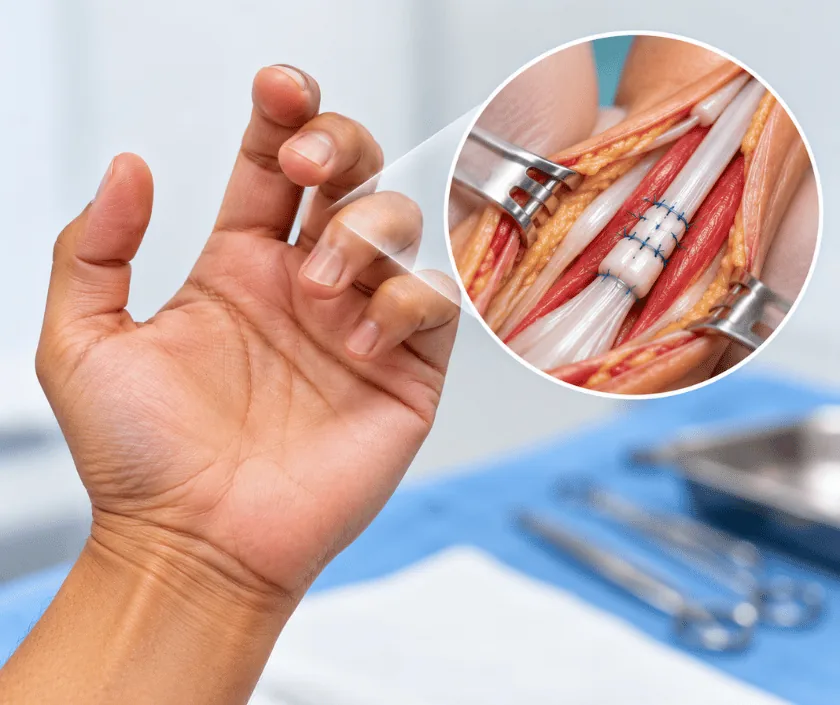
Flexor tendon repair is surgery to rejoin the cords that bend the fingers after they are cut, usually by glass or a blade. The tendon ends are found, drawn back together and stitched with strong sutures. Surgery is only half the treatment, because supervised hand therapy over the following weeks is what turns a healed tendon into a working finger.
Flexor tendons are smooth cords running along the palm side of each finger, connecting the forearm muscles to the finger bones. When one is cut, the muscle pulls the loose end away up the hand, so the finger simply will not bend at that joint no matter how hard you try. A cut tendon does not heal by itself, and waiting makes matters worse because the ends shorten and the sheath they glide through scars closed.
Surgery is done through a small extension of the wound, usually under a regional block that numbs the whole arm. The two ends are retrieved, brought together and joined with strong core sutures and a fine running stitch around the join. Any cut nerve or artery alongside is repaired at the same time under magnification. Afterwards a splint holds the wrist and fingers in a protected position. From the first days a hand therapist starts a careful movement programme, because a repaired tendon left completely still sticks to its sheath, and a tendon moved too hard can rupture.
Each joint is tested separately to see which tendon is cut, and feeling in the finger is mapped. Knowing whether one or both flexor tendons are divided shapes the repair and the therapy that follows.
A regional block numbs the arm. The wound is extended along natural creases so the tendon sheath can be opened neatly, giving access without damaging the pulleys that hold the tendon close to bone.
The cut end that has retracted into the palm is gently drawn back with a fine instrument. Handling the tendon as little as possible protects its surface and helps it glide well later.
Strong core sutures join the ends, and a fine stitch smooths the join so it passes through the sheath. The repair is tested by moving the wrist and watching the finger bend before closing.
A protective splint is applied with the wrist and fingers positioned to take tension off the repair. Hand therapy is arranged within days, and the programme is explained to you before you leave.
The hand stays in the splint and is kept raised to control swelling. Therapy starts early with gentle guided movement. The rule at this stage is simple: no gripping, lifting or using the hand for daily tasks.
Sutures come out and the therapist increases the range of guided movement. The splint is still worn, including at night. Doing extra exercises on your own is not helpful and can rupture the repair.
The splint is usually discarded and active bending against light resistance begins. Stiffness is common now, and consistent attendance at therapy is what separates a good result from a poor one.
Strengthening builds up and heavier work is gradually allowed. Grip keeps improving for several months. Where a finger stays stiff or the tendon has stuck down, a release procedure can be considered.
Tendon surgery in the finger is delicate, and the result depends on healing as well as technique. These risks are explained before consent.

Cost varies with how many tendons are cut, whether a nerve or artery needs repair at the same time, the anaesthesia used and whether a tendon graft or staged reconstruction is required. Hand therapy sessions afterwards are charged separately and should be budgeted for, since they are essential rather than optional. Injuries at work or from an accident are usually admissible under mediclaim. A written estimate is shared after the hand is examined.
These are the questions that come up most often in consultation. If yours is not here, send it on WhatsApp and the team will reply, usually the same day.
Ask your question →The usual band is Rs 40,000 to Rs 85,000, depending on how many tendons are involved, whether a nerve or artery also needs repair, and the anaesthesia used. Hand therapy is billed separately. Mediclaim commonly applies for injuries at work or after an accident.
Within the first two weeks wherever possible, and sooner is better. The cut ends shorten with time and the sheath scars, which can turn a straightforward repair into a graft or a staged reconstruction with a longer recovery.
A repaired tendon must move to stop it sticking to surrounding tissue, yet move gently enough not to snap. Only a trained therapist can balance that. Skipping sessions is the most common reason a technically sound repair ends up stiff.
Many people regain good, useful bending, though a small loss of full movement is common. The outcome depends on how clean the cut was, which zone of the finger it crossed, and how closely the therapy programme is followed.
Light use usually begins around six weeks, with heavier gripping and lifting from about three months. Manual jobs and sport need clearance from the surgeon and therapist first, since returning too early risks rupturing the repair.
It shows up as a finger that was bending and suddenly stops. Tell the team the same day, because early repeat surgery is usually easier than late repair. Do not wait for the next scheduled appointment to report it.
The hand is examined joint by joint, sensation is tested and the wound is inspected. You then hear the zone of injury, the repair plan, the splint, the therapy schedule and the time off work, and receive a written estimate.
Each technique below has its own page explaining how it works and when it is chosen.
Seeing patients from across the city and beyond: read about the practice on the plastic surgeon in Surat page, or check what a written estimate covers on the costs and insurance page.
