Some radial nerve injuries never recover, leaving the wrist and fingers unable to lift. Tendon transfer borrows working muscles from elsewhere in the forearm and reroutes them to do that job, which is reconstruction rather than nerve repair.
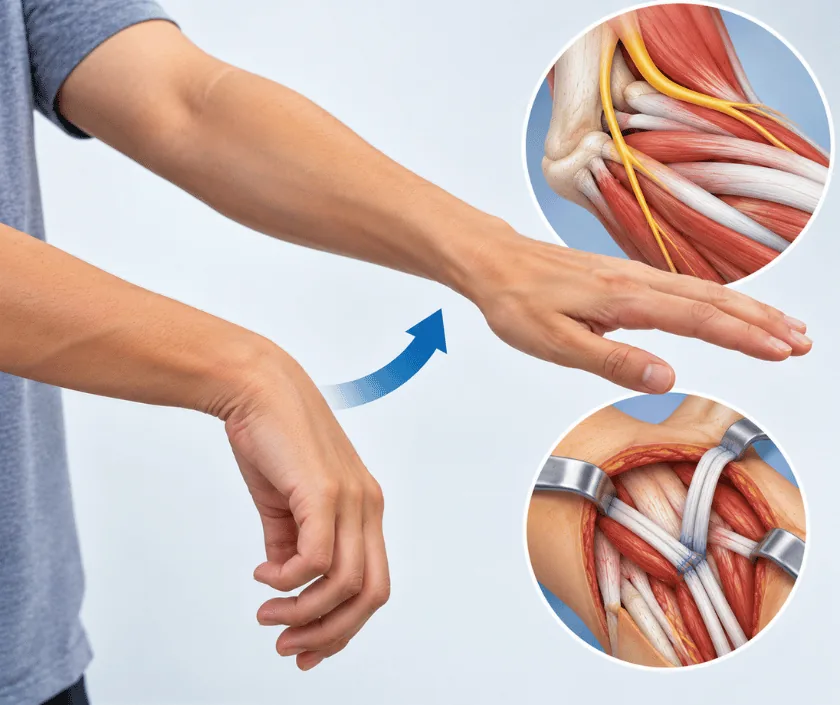
Tendon transfer for radial nerve palsy takes tendons still working under other nerves and attaches them to the tendons that lift the wrist, fingers and thumb. Nothing is done to the injured nerve itself. This is a reconstruction that replaces lost movement, chosen once nerve recovery has been ruled out or has failed to arrive.
Radial nerve palsy leaves a hand that closes but cannot open. Fingers still curl, because their bending muscles run under a different nerve, yet the wrist drops and the knuckles will not straighten. For many patients the nerve eventually recovers. When months pass with no return of power, or the nerve is known to be beyond repair, attention shifts from the nerve to the muscles.
The idea is straightforward. Several forearm muscles are still working normally under the median nerve, and some of them do jobs the hand can spare. Detaching one of those tendons and stitching it into the tendon that lifts the wrist gives that movement a new engine. Two more transfers are usually added, one to straighten the fingers and one to open the thumb.
It helps to be clear about what this is not. Nothing is repaired or grafted in the nerve itself, and feeling on the back of the hand is not changed. What returns is movement, borrowed from elsewhere, which is why the operation belongs to reconstructive surgery rather than to nerve surgery.
Transfers suit people whose nerve will not recover but whose joints remain supple and whose donor muscles are strong.
Each candidate muscle is tested for strength and the joints checked for full passive movement. A muscle that is weak or a joint that is stiff will not give a good result.
The arm is numbed with a block, or general anaesthesia is used. Incisions are made on the front and back of the forearm to reach the donor and recipient tendons.
Selected tendons are detached from their usual insertion and passed around the forearm to reach the tendons that lift the wrist, fingers and thumb.
Every transfer is stitched at a carefully judged tension, since too loose gives weak lift and too tight stops the hand closing. Balance here decides the result.
Wounds are closed and a splint holds the wrist and fingers in the protected position. Therapy begins once healing allows, retraining each new movement.
The arm is elevated in the splint and discomfort is managed with simple medication. Movement is not permitted yet, because the joins are still fragile.
Sutures and wounds are checked. Splinting continues, and a therapist begins teaching the movements you will start once protection can be reduced.
Support usually eases and active training begins in earnest. Learning to fire the transferred muscle for its new job takes concentration at first.
Most patients are using the hand for daily tasks by now. Strength and smoothness continue to improve as the movement becomes automatic.
Tendon transfers usually give a hand that works well for daily life, though not one that matches the uninjured side. Power is limited by the strength of the donor muscle, and fine coordination takes time as the brain learns its new task. Feeling on the back of the hand is unchanged, since only movement has been reconstructed. Results depend heavily on joint suppleness beforehand and on therapy afterwards.
This is planned reconstructive surgery, and it is worth understanding what may not go to plan.
The splint protects the joins while the tendons knit, and therapy teaches the hand its new pattern.
It does not touch the nerve at all. Working muscles are rerouted to replace a lost movement, which is a different kind of operation.
Only movement is reconstructed. Numbness on the back of the hand comes from the nerve and remains unchanged by this surgery.
Tendons must knit first, then the brain has to learn to use the muscle differently, so control develops over weeks of therapy.
Waiting has a limit. Stiff joints and wasted muscles reduce what a transfer can achieve, so timing is discussed rather than left open.
Tendon transfers at Elegance Clinic in Surat are planned with the therapist involved from the start, because the training afterwards decides how well the new movement works.

Cost for tendon transfer surgery depends on how many transfers are needed, whether the wrist, fingers and thumb are all addressed, and how long the operation runs. Splints and the therapy programme afterwards form a real part of the total and are included in the discussion. A written estimate is prepared after your assessment, covering surgery, anaesthesia, hospital charges and planned review visits. Where the original injury happened at work or on the road, insurance or employer cover may apply.
These are the questions that come up most often in consultation. If yours is not here, send it on WhatsApp and the team will reply, usually the same day.
Ask your question →The total reflects how many transfers are performed, the length of theatre time, the splints required and the therapy sessions afterwards. A written estimate follows your assessment, covering surgery, anaesthesia and planned reviews so you can plan ahead.
Tendon transfer is well established and usually done under a block or general anaesthesia. Infection, stiffness, adhesions and a transfer that needs adjusting are the main concerns, and each is explained before consent is taken.
The splint stays on for several weeks while the tendon joins heal. Active retraining then begins, and most people use the hand for daily tasks within a few months. Strength keeps building for a good while afterwards.
Many patients regain useful lifting of the wrist, fingers and thumb, enough for everyday work. Power is limited by the donor muscle, and speed and fine coordination usually stay below the uninjured side.
No. This operation reconstructs movement only, using tendons rather than nerves. Sensation on the back of the hand depends on the injured nerve and is not altered by transferring tendons.
Usually after enough time has passed to show that nerve recovery is not coming, judged by repeated examination and nerve studies. Waiting far beyond that point allows joints to stiffen, which reduces what surgery can achieve.
Donor muscles are tested for strength, joints checked for full passive movement and the pattern of loss recorded. The difference between nerve repair and reconstruction is explained, along with a written estimate before any decision.
Seeing patients from across the city and beyond: read about the practice on the plastic surgeon in Surat page, or check what a written estimate covers on the costs and insurance page.
