Bone responds to slow, steady stretching by making more of itself. Bone transport uses that property to fill a gap in the leg, and the whole process asks for patience measured in months rather than weeks.
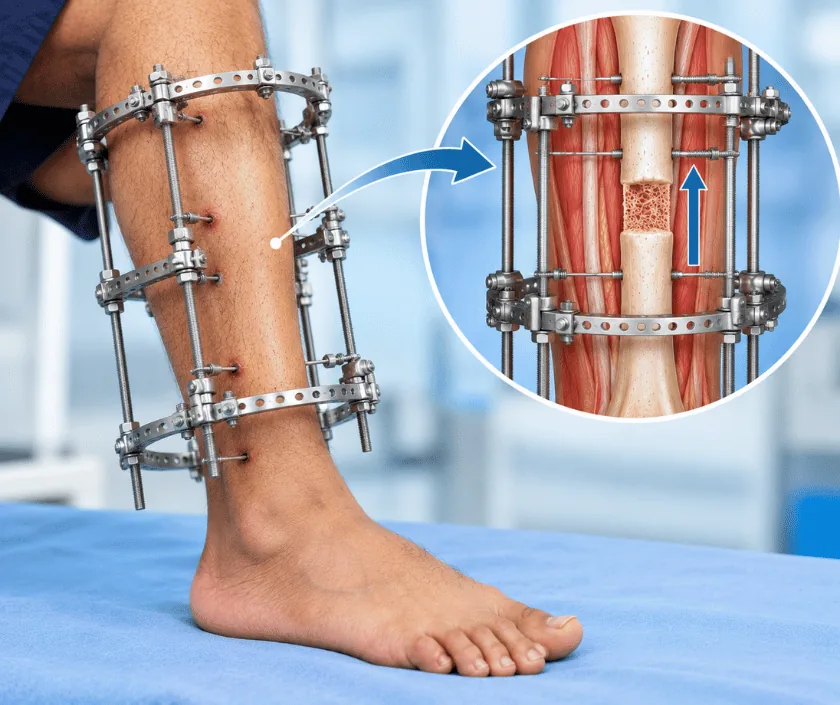
Bone transport moves a segment of your own bone gradually across a gap using an external frame. As the segment travels, new bone forms behind it in the space left open. Movement is tiny, typically fractions of a millimetre several times a day, and the frame stays on for months while the new bone matures.
Bone is living tissue and it responds to how it is loaded. If a cut is made in healthy bone and the two ends are separated very slowly, the body lays down new bone in the widening space rather than simply forming scar. Surgeons use that behaviour deliberately. A segment of bone above or below the defect is cut free, then moved a fraction of a millimetre at a time towards the gap using an external frame.
Treatment falls into three phases. After surgery there is a short waiting period before movement starts. Transport then proceeds daily, and the pace is deliberately slow, because moving too fast produces weak bone while moving too slowly lets the ends unite early. Once the segment reaches the far end of the gap, the longest phase begins, during which the new bone hardens enough to carry weight.
Frames are visible and take adjustment. Clothing needs altering, sleeping takes practice and pin sites need daily attention. Support at home makes a real difference through these months.
Transport suits people who need bone rebuilt and who can genuinely commit to months of frame care and regular review.
Imaging shows the size of the gap and the alignment of the leg. The type of frame and the level of the bone cut are worked out before surgery, along with the expected timeline.
The frame is fitted and a controlled cut is made in healthy bone away from the defect. Pins and wires hold the segments, and any residual infected tissue is cleared.
A short period passes before movement begins, allowing early healing tissue to form at the cut. Walking with support usually starts during this time.
Small daily adjustments move the segment across the gap. You are taught exactly how to turn the frame, and imaging checks progress at regular intervals.
Once the gap is filled, the frame stays on while new bone hardens. This phase is the longest, and imaging decides when the frame can safely come off.
Pain relief and elevation are the priority. Pin site care and the adjustment routine are taught, and walking with a frame or crutches begins under supervision.
Adjustments usually start. Reviews are frequent at first so the pace can be checked, and physiotherapy works on knee and ankle movement.
Transport continues with regular imaging. Weight bearing is guided by the surgical team, and stiffness is tackled through daily exercises.
Consolidation continues after transport is complete. The frame comes off once imaging shows the new bone can take load, and a brace is often used afterwards.
Transport can restore a leg that carries weight, though the road is long and demanding. Pin site scars remain, some difference in length or alignment may persist, and joint stiffness is common. Further small procedures are often needed along the way. Recovery can vary considerably, so progress is judged by imaging and function rather than by a fixed timetable.
Frames bring their own set of problems alongside the usual surgical risks, and most are manageable if reported early.
Most of this treatment happens at home, so the daily routine carries much of the responsibility for a good outcome.
Moving too quickly produces weak bone that fails. The prescribed pace exists because bone forms at its own rate.
Mild irritation is common and usually settles with careful cleaning. It should still be reported so it can be assessed.
Filling the gap is only the halfway point. The new bone then needs months to harden before it can take weight.
Alignment and rotation are corrected at the same time, which matters as much as length for comfortable walking.
Frame treatment depends on what happens at home, so teaching is done thoroughly before discharge and repeated at review. Elegance Clinic makes the length of the programme clear from the beginning.

Frame treatment runs over many months, so the estimate covers the surgery, the frame itself, repeated imaging, review visits and physiotherapy. Additional procedures are sometimes needed if the new bone consolidates slowly, and that possibility is explained at the outset.
A written estimate is prepared after assessment so families understand the commitment involved. Where accident cover or an employer scheme applies, the office will guide you through the documents usually requested.
These are the questions that come up most often in consultation. If yours is not here, send it on WhatsApp and the team will reply, usually the same day.
Ask your question →Many months, and longer gaps take longer still. Moving the segment is only part of it, since the new bone then needs a lengthy period to harden. Imaging at each review decides when the frame can safely be removed.
Flap cover after an open fracture sits in the band Rs 1.8L to Rs 4.5L, and the figure is case based. A written estimate covering surgery, the frame, imaging and physiotherapy is prepared after assessment so families can plan realistically.
You or a family member, after being taught carefully in hospital. The schedule is written down and demonstrated more than once. Reviews check that the pace is right and adjust it when imaging suggests a change.
Discomfort is usual, particularly in the early weeks and around adjustments, but it is generally manageable with ordinary pain relief. Sharp pain that keeps increasing is not expected and should be reported rather than endured.
Most people walk with crutches or a walker for much of the period, and that loading actually helps the new bone form. How much weight is allowed is decided at each review and may change as treatment progresses.
It is not unusual. The pace may be altered, or a small operation to add bone graft may be advised to help consolidation. Regular imaging is precisely what allows this to be picked up early.
Often yes, for a period. Newly formed bone can fracture if it is loaded fully too soon, so a brace or cast protects it while strength builds. The team will advise how long that protection is needed.
Each technique below has its own page explaining how it works and when it is chosen.
Seeing patients from across the city and beyond: read about the practice on the plastic surgeon in Surat page, or check what a written estimate covers on the costs and insurance page.
