Radical reduction surgery removes the thickened fatty tissue that has built up in a longstanding swollen limb, while keeping the overlying skin as living flaps. Preserving that skin gives a smoother contour than grafting and avoids resurfacing the whole leg.
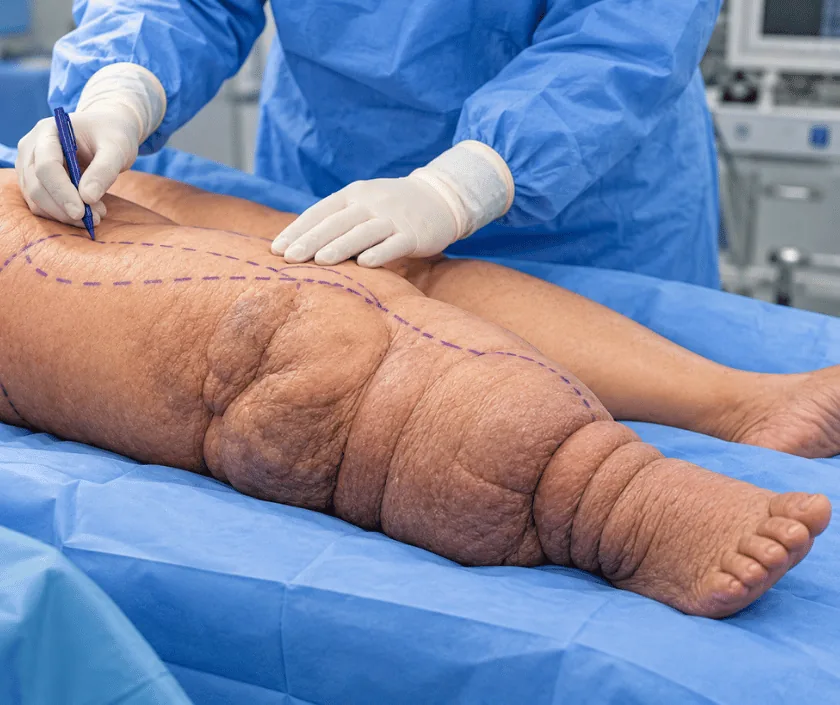
Radical reduction surgery removes excess fibrous and fatty tissue from a heavy lymphedema limb through long incisions, raising the skin as flaps and preserving their blood supply so grafting is not needed. It is used for later stage limbs that no longer pit. Surgery is often staged, and compression therapy continues throughout and afterwards.
By the later stages of lymphedema, a limb carries a thick layer of fibrous, fatty tissue that no garment can shift. Older operations solved this by removing skin along with that layer and grafting the raw surface. Radical reduction surgery takes a different route. Long incisions are used to lift the skin as flaps, the diseased tissue underneath is removed, and the flaps are then trimmed and laid back down over the smaller limb.
Keeping the skin alive depends on the small vessels that pass up into it. Surgery is planned around preserving as many of these as possible, which is one reason the operation is often staged, with the inner side of the limb treated at one sitting and the outer side some months later. That interval allows the blood supply to recover before the second stage.
The result is a limb reduced considerably in bulk yet still covered by its own skin, which usually gives a smoother contour and more durable surface than grafting. What has not changed is drainage. Fluid still gathers, so compression garments and skin care continue after healing, exactly as before surgery.
This surgery is for the later, fatty and fibrotic stage of lymphedema, and it works best in patients whose skin is still in reasonable condition.
Staging, measurement and skin assessment confirm that fibrous fatty tissue predominates. The staging plan is agreed, including which part of the limb is treated first.
A course of decongestive therapy is usually completed first, so the surgery addresses genuine tissue bulk rather than fluid that could be moved without an operation.
Through a long incision, skin is lifted as a flap while the small vessels supplying it are protected as far as possible. Careful handling here governs healing later.
Thickened fibrous and fatty tissue is removed from beneath the flap, reducing the circumference of the limb. Bleeding is controlled carefully throughout.
Excess skin is trimmed, the wound is closed over a drain and compression is applied. The second stage is planned once the limb has fully healed.
A hospital stay of several days is usual. The limb is elevated, drains manage fluid collection and wound edges are watched closely.
Drains are removed as output settles and dressings are reviewed. Walking or gentle limb use begins under guidance, avoiding tension on the wound.
Most patients are back to light routine by now. Compression is fully re established and measurements are compared with the baseline.
Scars soften over the following year. A second stage may be planned, and garment use continues with refitting as the limb settles.
Most patients see a clearly smaller limb, and keeping their own skin usually gives a better shape than grafting. Long scars remain along the limb and the contour is not entirely even. Drainage is unchanged, so garments continue and the limb will swell again if compression stops. Staged surgery means the final result may take a year or more to appear.
This is major surgery on a limb with impaired healing, so wound complications are the main concern and they are not rare.
Wound healing and a prompt return to compression decide how well the result holds, so these points matter more than they may seem.
Surgery is frequently staged to protect the blood supply to the skin. Treating one side at a time and waiting between stages is deliberate, not a setback.
Bulk is removed while drainage stays impaired. Compression and skin care continue, and the limb swells again if they are abandoned.
Fluid predominant limbs are treated with therapy or drainage surgery first. This operation is for later stage limbs where fibrous and fatty tissue dominates.
Scars run along the limb and remain visible, though they soften over a year. Most patients accept them for the reduction in size and weight.
Elegance Clinic in Surat plans reduction surgery in stages with healing as the priority. Dr. Ashutosh Shah explains why the skin is preserved, why the operation is often split and what continues afterwards.

Cost depends on how much of the limb is treated, theatre and anaesthesia time, hospital stay and whether surgery is staged. A staged plan means two admissions, and that is made clear in the estimate rather than appearing later as a surprise.
Compression garments, refitting as the limb reduces and therapy afterwards sit outside the surgical figure. A written estimate is prepared after assessment and before admission so the full commitment is visible from the beginning.
These are the questions that come up most often in consultation. If yours is not here, send it on WhatsApp and the team will reply, usually the same day.
Ask your question →It depends on how much of the limb is treated, theatre and anaesthesia time, hospital stay and whether the plan is staged across two admissions. Garments and therapy afterwards are separate. A written estimate is prepared after assessment and before admission.
It is major surgery on a limb that heals slowly, so wound breakdown, infection and fluid collections are genuine risks. Preserving the blood supply to the skin is central to the technique, and staging the operation is one way that risk is reduced.
Expect several days in hospital, then a gradual return to routine over roughly six to eight weeks. Wounds are reviewed frequently in the early period. If surgery is staged, the second operation follows once the limb has healed fully.
Reduction is usually substantial, since dense fibrous tissue that compression cannot move is removed directly. Keeping your own skin generally gives a better shape than grafting. Long scars remain and the contour is not entirely even.
Because the skin depends on small vessels that could be disrupted if the whole circumference were operated on at once. Treating one side and allowing the blood supply to recover before the second stage protects healing considerably.
Yes, indefinitely. The operation removes bulk without repairing drainage, so fluid still accumulates. Garments are refitted as the limb settles at its smaller size, and stopping them allows the swelling to return over the following months.
That operation removes the skin along with the underlying tissue and resurfaces the limb with grafts. Here the skin is preserved as living flaps, which usually gives a smoother, more durable surface, provided the skin is healthy enough to survive.
Each technique below has its own page explaining how it works and when it is chosen.
Seeing patients from across the city and beyond: read about the practice on the plastic surgeon in Surat page, or check what a written estimate covers on the costs and insurance page.
