When a limb has been swollen for years, much of the extra bulk is no longer fluid but fat. Suction assisted lipectomy removes that fatty tissue through small openings, which compression alone can never achieve.
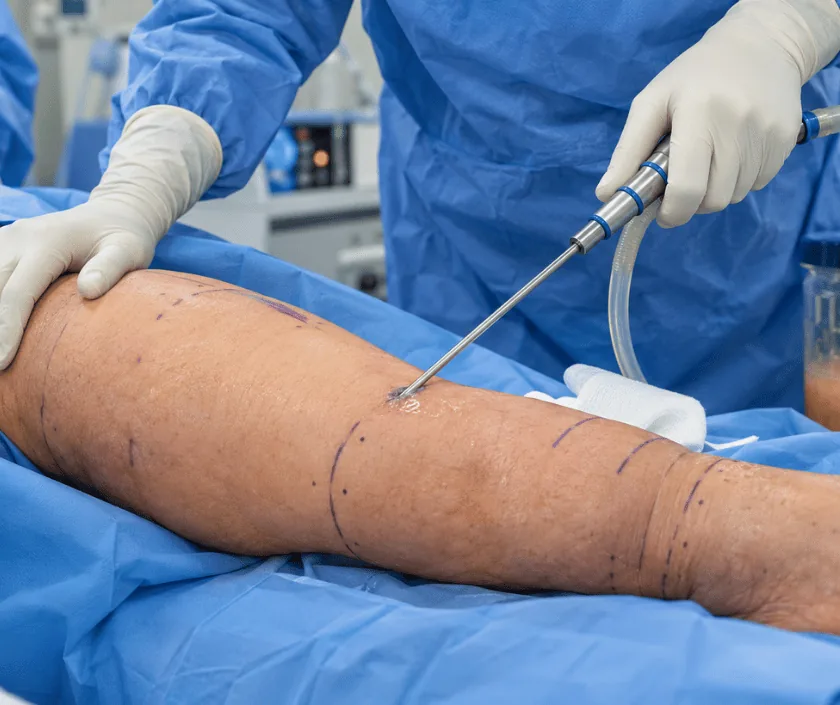
Suction assisted lipectomy uses liposuction technique to remove the fatty tissue that builds up in longstanding lymphedema. It is offered when the limb no longer pits and drainage treatments have stopped reducing it further. Compression garments are applied immediately after surgery and worn continuously afterwards, because the operation removes bulk without repairing drainage.
Lymphedema does not stay the same over the years. In the early phase the extra volume is protein rich fluid, which is why elevation and compression work so well. As time passes the body responds to that fluid by depositing fat and laying down fibrous tissue, and the limb slowly stops pitting under thumb pressure. At that point a garment can hold the limb steady, yet it cannot make it smaller, because there is little fluid left to move.
Suction assisted lipectomy addresses exactly this problem. Working through several small openings, a narrow cannula removes the fatty tissue along the length of the limb. The technique is careful and methodical, aiming to reduce bulk while doing as little harm as possible to whatever lymphatic channels survive.
What the operation does not do is restore drainage. Any fluid tendency remains, so a compression garment is applied at the end of the procedure and worn continuously afterwards. Patients who cannot commit to that routine are usually advised against the operation, because the limb refills and the gain is lost.
This procedure is for a later stage of lymphedema and it asks a good deal of the patient afterwards. Both points are discussed frankly before it is planned.
Measurements, staging and skin assessment confirm that fat rather than fluid dominates. Garments are ordered in advance so compression can be applied as soon as surgery finishes.
A course of decongestive therapy is often completed first. Removing fluid shows what fatty bulk truly remains and makes the surgical plan more accurate.
Under general anaesthesia, several small openings are made along the limb and a narrow cannula removes fatty tissue systematically, working circumferentially rather than in isolated patches.
A garment or bandaging is applied on the operating table. This step is not optional, since compression from the outset controls swelling and shapes the result.
Compression continues without interruption, therapy resumes as healing allows, and measurements at review visits track how well the limb is holding its reduced size.
A short hospital stay is usual. The limb is bruised, tender and firmly compressed, and the garment stays on other than for supervised changes.
Bruising begins to settle and openings heal. Compression continues day and night, and light activity is encouraged within comfort.
Most patients are back to routine work by now. Measurements are compared with the baseline and garments are reassessed as the limb settles.
The shape of the limb becomes clearer as swelling from surgery resolves. Garment use continues, with replacements planned at regular intervals.
Many patients see a substantially smaller limb, and that change tends to hold provided compression is worn faithfully. The operation does not repair drainage, so the tendency to swell remains for life and garments continue. Skin that has been stretched for years may not shrink neatly around the smaller limb. Results also depend on weight, since weight gain adds fatty tissue back.
This is a bigger undertaking than it may sound, since a whole limb is treated rather than one small area.
Compression is the heart of aftercare here, and the result depends on it more than on anything else you do.
The technique is similar but the purpose, the extent and the aftercare are quite different. Treating a whole limb and wearing compression for life are not part of cosmetic surgery.
Drainage remains impaired, so the limb refills with fluid without compression. Garment use continues indefinitely and is discussed clearly before surgery.
Limbs still full of fluid are treated with therapy or microsurgery first. Suction is aimed at later stage limbs where fat has become the main problem.
Size can come much closer, but stretched skin, scars and contour irregularities mean the limb usually still looks different.
Elegance Clinic in Surat only offers this operation when the limb has genuinely reached the fatty stage and the patient is ready for the garment routine that follows. Dr. Ashutosh Shah discusses both requirements openly before booking.

Cost depends on the size of the limb treated, theatre and anaesthesia time, hospital stay and the garments required. Garments are a significant part of the total here, since more than one is needed and refitting follows as the limb reduces.
Because those factors vary so much between patients, a written estimate is provided after assessment and before admission. It sets out surgery, stay and the expected garment schedule, so the ongoing commitment is visible from the beginning.
These are the questions that come up most often in consultation. If yours is not here, send it on WhatsApp and the team will reply, usually the same day.
Ask your question →It depends on limb size, theatre and anaesthesia time, hospital stay and the garments needed afterwards. Garments form a real part of the total, since refitting follows as the limb reduces. A written estimate is issued after assessment and before admission.
It is a larger procedure than cosmetic liposuction, so blood loss, infection and altered sensation are genuine considerations. Fitness is assessed carefully, the limb is prepared beforehand and compression is applied in theatre to control swelling from the outset.
A short hospital stay is usual, followed by bruising and tenderness that settles over the first weeks. Many patients return to routine work in about three to four weeks. Compression is worn throughout, including at night in the early period.
Many patients see a substantial reduction, since the fatty bulk that compression could not touch is removed directly. Holding that result depends on wearing garments consistently. Skin stretched over years may stay loose even when the limb underneath is smaller.
Yes, and this is the most important point to understand beforehand. The operation removes bulk without repairing drainage, so the limb refills with fluid if garments are abandoned. Patients unable to commit to this are advised against surgery.
Usually yes. A course of decongestive therapy removes fluid and reveals how much fatty tissue truly remains. That makes the surgical plan more accurate and also shows whether you can sustain the garment routine that follows.
Sometimes. Drainage procedures suit fluid predominant limbs while suction addresses fatty bulk, and occasionally both are planned in a staged sequence. What suits your limb is decided after staging, imaging and a full discussion.
Seeing patients from across the city and beyond: read about the practice on the plastic surgeon in Surat page, or check what a written estimate covers on the costs and insurance page.
