Above the angle, the lower jaw rises as a flat plate of bone called the ramus, sandwiched between two thick chewing muscles. That muscle cover changes both how the fracture behaves and how it is best treated.
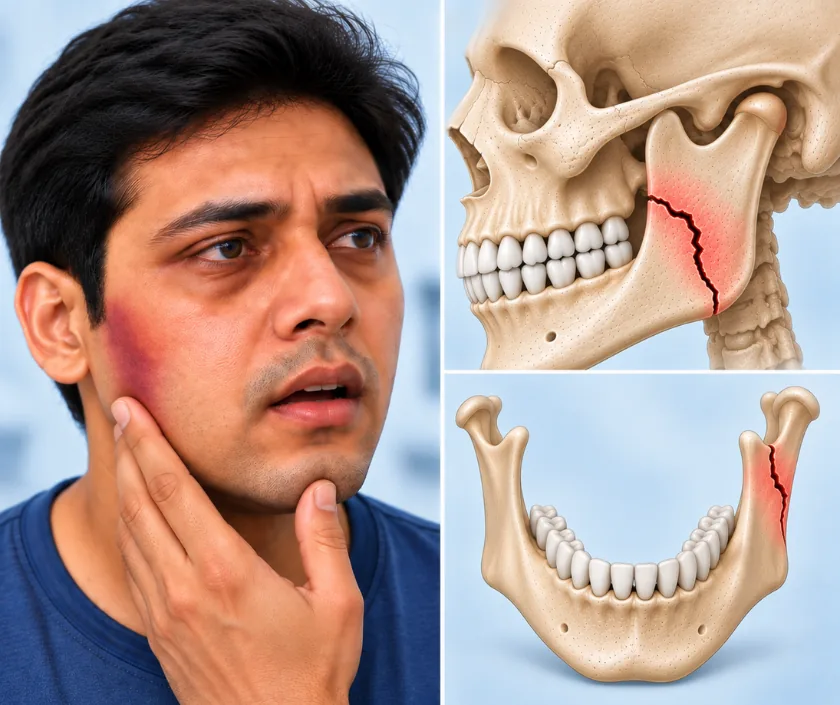
A ramus fracture is a break in the vertical part of the lower jaw, above the angle and below the joint. Thick muscle covers both faces of this bone and acts as a natural splint, so many of these fractures move very little. Treatment is therefore often closed, with plates reserved for breaks that have shifted or shortened the jaw.
If the body of the jaw is the part you can trace under your cheek, the ramus is the part you cannot easily feel at all. It rises behind the last molar, hidden under the broad chewing muscle on the outside and another strong muscle on the inside. Those two muscles grip the bone like a sling, which is exactly why this region behaves differently from the rest of the jaw.
When the ramus cracks, the muscle sling usually holds the pieces close together. Many people therefore have less obvious deformity than they expect after a heavy blow, and the main complaints are pain behind the last tooth, difficulty opening and a bite that meets unevenly. Scans are often what reveal the true extent of the break.
The decision that follows is a genuine choice rather than a formality. Reaching this bone means working through muscle, and an approach from the skin runs close to the nerve that moves the face. So when the fracture has hardly moved, holding the teeth in the correct bite with elastics for a period and letting the muscle sling do its work is a reasonable path. When the ramus has shortened or split apart, plates are used to rebuild that height.
Not every ramus fracture is plated. The question is whether the height and alignment of the jaw have been lost, and whether the bite can be restored without opening the muscle.
Bite, jaw opening and facial movement are examined first. Scans then show whether the ramus has shortened, how many pieces there are and whether the joint above is also broken.
The team weighs closed treatment against fixation. Displacement, the state of the bite and the presence of other fractures decide the choice, and the reasoning is shared with the patient.
The teeth are held in the correct bite with elastics on arch bars or bone screws for a set period. Elastics are adjusted at review, then eased off as guided movement begins.
Under general anaesthesia the fracture is reached, usually through the mouth with instruments passed behind the last tooth. Plates are then fixed to rebuild the height of the ramus and hold the pieces.
Guided jaw exercises start once fixation or elastics allow. The bite is rechecked at every visit, since small shifts are easier to correct early than late.
Pain sits deep behind the jaw and opening is limited. Liquids and blended food are the mainstay, with regular pain relief and cold compresses.
Swelling settles. People on elastics learn to manage speech and nutrition, while those with plates begin gentle opening exercises as advised.
Elastics are usually finished by now and the diet begins to widen. Opening exercises continue, because muscle stiffness outlasts bone healing at this site.
Chewing strength returns gradually. Any lasting restriction in opening is reassessed, and physiotherapy is extended if the mouth is still tight.
Most ramus fractures heal with a bite that feels normal and a jaw that opens well, whether they are treated closed or with plates. Stiffness is the usual sticking point, and opening can take several weeks of steady exercise to return. A few people notice mild aching in the muscle when chewing hard food for months afterwards. Outcomes vary with the energy of the injury and with how consistently exercises are done.
Both routes carry risk, and the balance between them is what shapes the treatment plan discussed at consent.
Recovery here rests on two habits: keeping the mouth clean and keeping the jaw moving in the way you were shown.
Closed treatment is an active plan with elastics, review and exercises, chosen because the muscle sling around the ramus already holds the bone well.
Early on, restricted opening usually comes from muscle spasm and bruising, not from the joint itself being blocked.
Removing them without instruction lets the bite drift, and correcting that later is far harder than tolerating the discomfort now.
Bone unites earlier than muscle recovers. Full opening and chewing strength usually need weeks of steady exercise beyond that point.
At Elegance Clinic in Surat, the choice between closed treatment and fixation for a ramus fracture is explained openly, with the reasons for each set out before anything is booked.

Treatment of a ramus fracture is medically necessary care and is usually covered by mediclaim, whether it is closed treatment with elastics or fixation with plates. The estimate reflects the route chosen, the number of fracture sites, implants used, room category and length of stay. Closed treatment generally costs less in hospital terms but needs more review visits, and that is explained when the plan is agreed. A written estimate is provided before admission.
These are the questions that come up most often in consultation. If yours is not here, send it on WhatsApp and the team will reply, usually the same day.
Ask your question →The ramus is gripped by thick chewing muscle on both faces, which holds many fractures in acceptable position. When the bite can be restored with elastics and the bone has hardly moved, closed treatment avoids operating through that muscle.
Usually a few weeks, with the exact period set by the fracture and by how the bite behaves at each review. Elastics are eased off gradually rather than stopped in one step, so the jaw relearns its position.
Fracture care after injury is generally covered by mediclaim, including both closed treatment and fixation. Cover depends on the policy and on insurer approval. Any later dental work is usually billed separately and is explained beforehand.
Blood and swelling within the chewing muscles make them tight, and they stay tight for a while after the bone settles. Regular gentle exercises usually restore opening over several weeks rather than days.
Not at first. A blended or soft diet is needed while elastics are on or while the bone unites, then firmer food is added once review confirms healing. Nutrition advice is given so weight loss is avoided.
Small differences often settle as swelling resolves and muscles relax. If the bite remains off, options range from dental adjustment to further surgery, and the choice depends on how far the jaw sits from its original position.
Return promptly for spreading swelling, fever, a foul taste, sudden change in the bite, or any weakness of the face on that side. Breathing difficulty or an inability to swallow saliva needs emergency care rather than an appointment.
Seeing patients from across the city and beyond: read about the practice on the plastic surgeon in Surat page, or check what a written estimate covers on the costs and insurance page.
