A Bernard flap rebuilds a lip when most of it has been lost, by sliding cheek tissue inward from both sides. Small triangles of skin are removed near the nose and mouth so the cheek travels without bunching up.
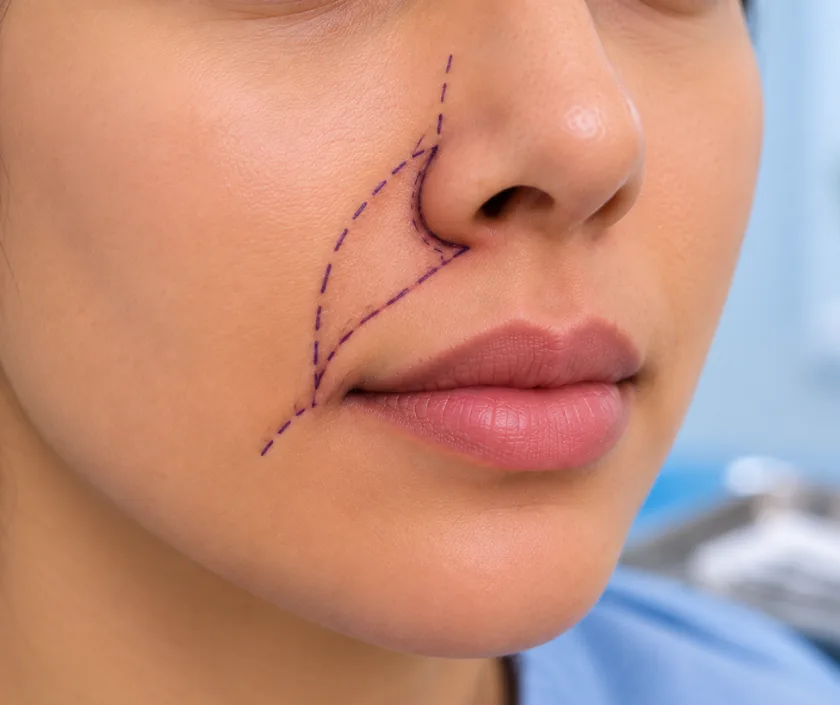
A Bernard flap is used when a very large part of the lip, sometimes almost all of it, has been lost. Cheek tissue on both sides is released and advanced towards the middle, with small triangles of skin removed so it slides flat instead of folding. Lining taken from inside the cheek forms the red part of the new lip.
Some injuries and cancers take nearly the whole lip. Nothing useful remains to borrow from the opposite side, and a graft would give a thin, immobile patch that neither holds saliva nor looks like a mouth. Tissue therefore has to come from somewhere close by, in enough quantity to rebuild both the skin outside and the moist lining inside.
Cheeks supply that tissue. Cuts are made outward from the corners of the mouth and the cheek on each side is released so it can slide towards the middle. Small triangles of skin near the fold running from nose to mouth are taken out, which lets the cheek travel without gathering into a bunch. Mucosa from inside the cheek is then turned outward to form the red part of the new lip.
What this cannot fully restore is movement. Muscle brought in from the cheek does not act like the ring that once circled the mouth, so the rebuilt lip tends to be stiffer and less sensitive. Therapy, and sometimes a further procedure, is used to improve control.
This is a large reconstruction, chosen when smaller flaps cannot cover the loss. Honest discussion about movement and sensation matters before agreeing to it.
The surgeon maps how much lip is missing, checks both cheeks for scarring and plans where the lining will come from. Photographs and measurements guide the design.
Cuts extend outward from the corners of the mouth and each cheek is freed so it can advance. Triangles of skin are removed to allow a flat slide inward.
Mucosa from inside the cheek is turned outward to form the red surface of the new lip, giving a moist edge rather than dry skin at the opening.
Lining, muscle and skin are stitched separately so the repair has depth. Attention goes to the level of the new lip edge on both sides.
Before discharge the team explains speech and swallowing therapy, the diet plan, and any refinement that may be considered once healing settles.
Swelling of the cheeks and lip is marked. Feeding is usually with fluids, pain relief is regular, and the mouth is kept clean with gentle rinses.
Swelling begins to fall and stitch lines settle. Soft food is introduced slowly, and leaking from the mouth is common at this stage.
Most people manage a soft diet and return to light activity. Therapy for speech and mouth control usually begins in earnest around now.
Scars fade and the lip softens. Movement and containment improve gradually, and further refinement is discussed once the tissue is quiet.
Expect a mouth that is closed, protected and workable rather than one that looks untouched. Containment of saliva usually improves over the first few months, helped by therapy. Movement stays limited, since the muscle ring cannot be fully rebuilt, and numbness in the new lip is common. Mouth opening may be tighter than before. Many patients find eating and speech improve steadily across the first year.
A reconstruction of this size carries more risk than a small flap, and the trade offs should be clear well before surgery.
Care at home is about protecting a big wound while slowly retraining the mouth to do its job again.
Grafts bring skin without muscle or lining. A lip built from graft alone stays stiff, dries out and cannot keep saliva inside the mouth.
Movement is the hardest thing to rebuild. This flap restores cover and containment first, and therapy then improves control as far as it can.
Even near total loss can be reconstructed. What changes is the size of the operation and the honesty needed about how the result will work.
Leaking is common early on while swelling settles and muscle control is retrained. It usually improves over the following months with therapy.
Large lip reconstructions at Elegance Clinic in Surat are planned with the therapy team from the start, because how the mouth works afterwards depends as much on rehabilitation as on the operation itself.

Charges reflect a long operation, the hospital stay, anaesthesia and any tumour surgery carried out at the same sitting. Therapy afterwards adds to the total, and staged refinement is quoted separately when it is planned. Reconstruction after cancer or trauma is generally admissible under mediclaim, and the team helps assemble the paperwork. A written estimate is prepared once the defect has been assessed.
These are the questions that come up most often in consultation. If yours is not here, send it on WhatsApp and the team will reply, usually the same day.
Ask your question →Charges reflect a long operation, the hospital stay, anaesthesia and any tumour surgery done at the same sitting. Therapy afterwards adds to the total. Because plans vary widely, a written estimate is prepared once the defect has been assessed.
Most policies cover reconstruction after cancer or trauma, as it restores function. Approval typically needs imaging, biopsy reports, photographs and a surgical plan. Since the stay is longer, room rent limits in your policy are worth checking well in advance.
It is a recognised reconstruction carried out under general anaesthesia, with fitness checked beforehand. Risks include bleeding, infection and partial loss of an advanced flap. Careful planning and close monitoring afterwards are how those risks are kept down.
Fluids come first, then soft food over several weeks. Leaking and drooling are common early and usually improve with therapy. Many people manage a soft normal diet within a couple of months, though tough food may stay difficult.
Movement is the hardest part to restore, because the muscle ring around the mouth cannot be fully rebuilt from cheek tissue. Closure and containment improve first, then therapy adds control. Expect a working mouth rather than a natural smile.
It is meant for very large losses. Smaller gaps do better with flaps that preserve movement. Cheeks that are scarred or previously irradiated, uncontrolled diabetes and continuing tobacco use all argue against proceeding until things improve.
Expect measurement of the defect, examination of both cheeks, photographs and a discussion of what the result will and will not do. Therapy needs are raised early. Bring imaging, biopsy reports and details of any previous surgery.
Seeing patients from across the city and beyond: read about the practice on the plastic surgeon in Surat page, or check what a written estimate covers on the costs and insurance page.
