Chin reconstruction rebuilds the part of the face that takes the impact in most falls and road accidents. Depending on what is missing, treatment may restore skin cover, soft tissue bulk, the bone beneath, or all three together.
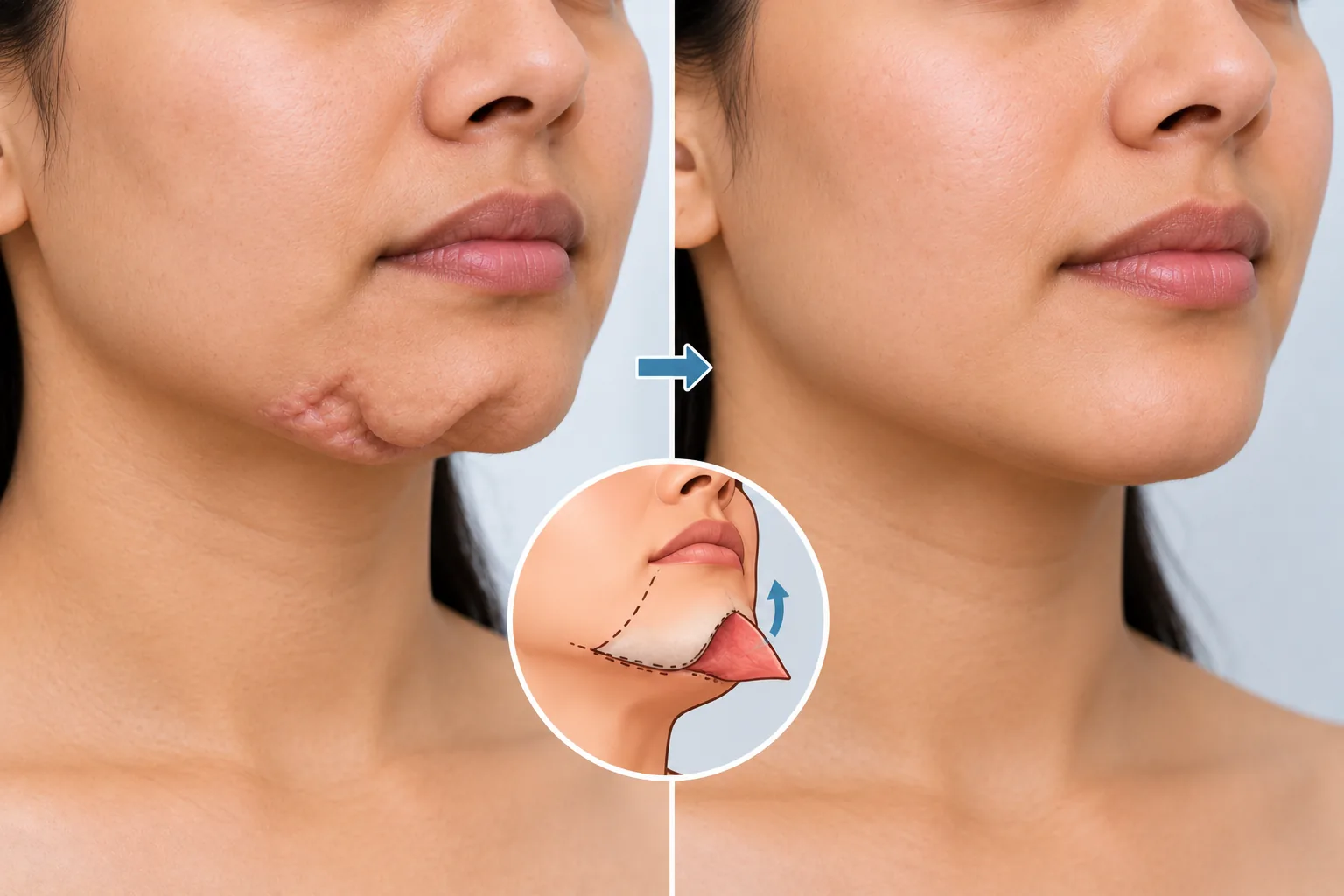
Chin reconstruction restores the front of the lower jaw after injury, infection or tumour removal. Work may involve moving nearby skin to cover a defect, adding soft tissue for shape, repairing or replacing bone, and protecting the nerve that carries feeling to the lower lip. Plans are staged when both bone and skin are missing.
Anatomy here is layered. Skin over the chin is thick and tethered, beneath it sits a pad of soft tissue with the muscles that lift the lower lip, and under those lies the front of the jaw bone carrying the lower front teeth. A nerve runs out on each side to supply feeling to the lip and chin. Injury may take one layer or several at once.
Assessment therefore starts by naming what is missing. A wound involving skin alone may close with careful local repair or a flap from nearby, which brings colour and thickness that match. Loss of soft tissue leaves a flat or dented chin even when the skin heals, so bulk may need to be added. Where bone is broken or gone, plates, bone grafting or a reshaping procedure may be needed to restore projection and the way teeth meet.
Timing matters as much as technique. Contaminated wounds are cleaned and settled first, dental problems are addressed alongside, and definitive shaping is often left until swelling and scarring have calmed.
What is offered depends on which layers are missing and on how settled the tissue is. Rushing definitive shaping into an inflamed wound rarely pays off.
Skin, soft tissue and bone are examined, sensation in the lower lip is tested, and imaging is arranged when the jaw may be fractured or missing bone.
Contaminated or infected tissue is cleaned and allowed to settle. Any dental treatment that affects the plan is arranged at this stage.
Where bone is broken or lost, it is fixed with plates or rebuilt with a graft. Projection and the way teeth meet guide the position chosen.
Skin is closed with a local flap or a graft depending on the size of the defect, and soft tissue is added wherever the contour looks flat.
Once swelling settles, scar revision or a small contour adjustment can be planned to improve the final shape.
Swelling and bruising spread down the neck. Fluids and soft food are easiest, and the lower lip often feels numb at this stage.
Stitches settle and swelling begins to fall. Speech and eating become easier, though chewing is still limited when bone has been repaired.
Bone work is usually stable and most normal activity resumes. Scars look red and feel firm, which is expected at this point.
Contour becomes clear as swelling fully settles. Sensation continues to return slowly, and any refinement is planned now.
Shape and profile usually improve a great deal, and relief from tightness or a discharging wound is often the bigger gain. Numbness of the lower lip and chin is common after injury here and may recover only in part. Scars fade across many months without disappearing. When bone has been rebuilt, small differences in projection remain possible, so a refinement procedure is sometimes planned later.
Surgery at the front of the jaw sits close to nerve, bone and teeth, so the risks deserve a plain conversation.
Protecting the repair while bone and soft tissue settle makes the biggest difference during the first weeks.
Implants add projection to an intact chin. Missing skin, soft tissue or bone has to be replaced first, otherwise the implant sits under tissue that cannot support it.
Recovery of the nerve varies. Many people regain useful feeling over months, while some are left with a patch that stays altered.
Complex chin injuries are often staged. Cleaning, bone repair, cover and later refinement each have their own right moment.
Safe access and secure closure sometimes need an incision. Placing it under the jaw line or in a crease is how it is made less noticeable.
Chin reconstruction at Elegance Clinic in Surat is planned layer by layer, with bone, soft tissue, nerve and dental needs considered together rather than in isolation.

Cost depends on what has to be rebuilt. Skin cover alone sits well below surgery that involves bone, plates or grafting, and a staged plan naturally costs more than a single sitting. Imaging, hospital stay and any dental work all add to the picture. Reconstruction after an accident, infection or tumour is generally admissible under mediclaim, while cosmetic chin shaping alone is not. A written estimate is prepared once imaging and examination are complete.
These are the questions that come up most often in consultation. If yours is not here, send it on WhatsApp and the team will reply, usually the same day.
Ask your question →Cost depends on what has to be rebuilt. Skin cover alone differs from surgery involving bone, plates or grafting, and a staged plan costs more than a single sitting. A written estimate is prepared once imaging and examination have been completed.
Reconstruction after an accident, infection or tumour is generally admissible under mediclaim, since it restores structure and function. Approval usually needs imaging, photographs, clinical notes and a surgical plan. Cosmetic chin shaping on its own is not covered.
Numbness is common after injury or surgery in this area, because the nerve supplying the lower lip runs close by. Feeling often returns over months, though recovery is not always complete. Any change is reviewed at each visit.
Soft food is advised at first, particularly when bone has been repaired. Many people move towards a normal diet across several weeks, guided by how the bone is healing. Hard and chewy items are left until much later.
Profile and contour usually improve markedly. Matching the original exactly is unlikely, especially after bone loss. Swelling hides the true shape for months, so refinement is judged once the tissue has settled rather than early.
Often yes. Bone at the front of the jaw carries the lower teeth, so bite problems and dental disease are addressed alongside reconstruction. Planning both together avoids a result that looks right yet does not function.
Bring any imaging already done, records of the original injury or surgery, dental details and a list of medicines. Expect examination of skin, bone, bite and lip sensation, along with photographs and a discussion of staging.
Each technique below has its own page explaining how it works and when it is chosen.
Seeing patients from across the city and beyond: read about the practice on the plastic surgeon in Surat page, or check what a written estimate covers on the costs and insurance page.
