A dog bite does two things at once, tearing tissue and driving bacteria deep into the wound. Treatment therefore starts with washing and with prevention of infection, and the timing of any repair is decided from there.
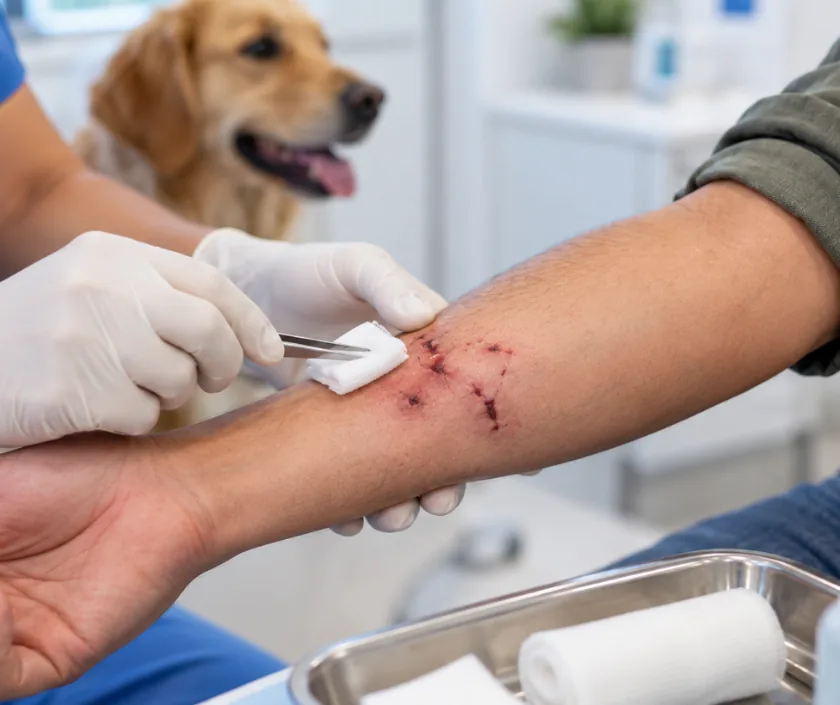
Dog bite reconstruction is the repair of tissue torn by a bite, carried out once the wound has been washed and the infection risk has been addressed. Because bites drive bacteria deep, many wounds are cleaned and dressed first, then closed a few days later. Facial bites are often an exception and may be repaired early.
Dog teeth do not cut cleanly. Canines puncture deeply while the jaw crushes and shears, so the visible wound often understates the damage. Bacteria from the mouth are carried right into that crushed tissue, where they are sheltered from washing and from the defences of the body. This is why a bite behaves differently from a knife wound of the same length.
Treatment begins with thorough washing, careful inspection for damage to tendon, nerve or bone, and removal of dead tissue. Tetanus protection is reviewed, and the treating team decides on rabies prevention according to national guidance and the circumstances of the bite. Antibiotics are commonly advised, particularly for deep wounds, hand wounds and people whose healing is impaired.
Only then does the question of closure arise. Many wounds, especially on the hand or limb, are dressed open and closed a few days later once they have stayed clean. Facial bites are often repaired sooner, because the face heals well and an untreated wound there leaves a difficult scar. Later reconstruction, such as scar revision or flap surgery, is planned once everything has settled.
Every bite wound needs assessment, though not every one needs surgery. Wound depth, its site and how many hours have passed all shape the plan.
The wound is examined for depth and for injury to tendon, nerve or bone. Circumstances of the bite are recorded, tetanus protection is reviewed, and the treating team advises on rabies prevention.
The wound is irrigated generously and crushed tissue is trimmed. Puncture tracks are opened where needed, so that cleaning reaches the depth of the wound rather than the surface only.
Facial wounds are often repaired at this stage. Hand and limb wounds are more often dressed open, with closure planned in a few days once the tissue has proved to be clean.
A course of antibiotics is usually prescribed for deeper bites. An early review is arranged, because the first two days show whether infection is developing.
Once healing is complete, remaining problems such as a wide scar, a notched lip or missing tissue are addressed with scar revision or flap surgery.
Swelling and soreness are usual. Dressings are checked, antibiotics are started as prescribed, and the wound is reviewed for early signs of infection.
Stitches on the face are removed early, and wounds left open are usually closed or well on the way to healing. Bruising fades over this period.
The wound is sealed and scar care is under way. Most people are back to normal activity, and children have generally returned to school and play.
Scars soften and fade. Any revision, such as improving a notch in the lip or a wide scar, is considered once the tissue has matured.
Most bite wounds heal well once they are cleaned properly and closed at the right time. A scar remains, and bites often leave a slightly irregular line because tissue was torn rather than cut. Children heal quickly yet scar actively, so redness can last many months. Where tissue was lost from the lip, nose or ear, a further reconstruction may be needed, and it is planned once growth and scar maturation allow.
Bite wounds carry a higher risk of trouble than most injuries of the same size, so it is fairer to say so plainly.
The first days at home are when infection either takes hold or is caught early, so the instructions matter.
Puncture wounds are the ones most likely to become infected, because bacteria are carried deep while the surface closes over them quickly.
Closing a contaminated bite can trap infection. Many wounds are cleaned, dressed and closed a few days later, which usually gives a safer result.
The bite still carries mouth bacteria into the tissue, and prevention advice depends on the animal, the circumstances and national guidance. A doctor decides that at the time.
Rinsing helps, though it cannot reach the depth of a puncture track. Proper cleaning of a deep bite is done with the wound opened under anaesthesia.
Bite injuries at Elegance Clinic in Surat are handled with cleaning first and closure timed to the site of the wound, with early review built into the plan.

Treatment after a dog bite is emergency and reconstructive care, so health insurance policies and many government schemes consider it once the injury is recorded. Cost depends on the depth and site of the wound, the anaesthesia used, whether closure is immediate or delayed, and whether later scar surgery is needed. A written estimate is given before any planned admission.
These are the questions that come up most often in consultation. If yours is not here, send it on WhatsApp and the team will reply, usually the same day.
Ask your question →Cost depends on the depth and site of the wound, the anaesthesia used, whether the wound is closed at once or after a few days, and whether later scar surgery is needed. A written estimate is given before any planned admission.
Bite treatment is medical and reconstructive rather than cosmetic, so mediclaim policies and government schemes generally consider it. Approval needs the injury record, photographs and hospital paperwork. Policy waiting periods, room rent limits and reporting deadlines still apply, so tell the insurer early.
Bites carry mouth bacteria deep into tissue, and stitching them immediately can seal that infection inside. Cleaning the wound and dressing it open for a few days often gives a safer result, and the wound is then closed once it has stayed clean.
Most surface wounds settle within one to two weeks, once swelling eases and stitches are removed. Hand bites take longer, since movement is restored gradually. Scars keep changing for months, so the final appearance is judged much later.
Some mark remains, because torn tissue heals with a less even line than a clean cut. Careful repair, scar care and sun protection all reduce how noticeable it is. Revision surgery can be considered once the scar has matured.
Children are often bitten on the face and may need general anaesthesia so that cleaning is thorough and repair is accurate. They heal quickly yet scar actively, so scar care and long review are more important, not less.
The wound is examined for depth and for tendon or nerve injury, and details of the bite are recorded. Tetanus protection is checked and advice on rabies prevention is given. Cleaning is carried out, and the plan for closure and review is explained in writing.
Each technique below has its own page explaining how it works and when it is chosen.
Seeing patients from across the city and beyond: read about the practice on the plastic surgeon in Surat page, or check what a written estimate covers on the costs and insurance page.
