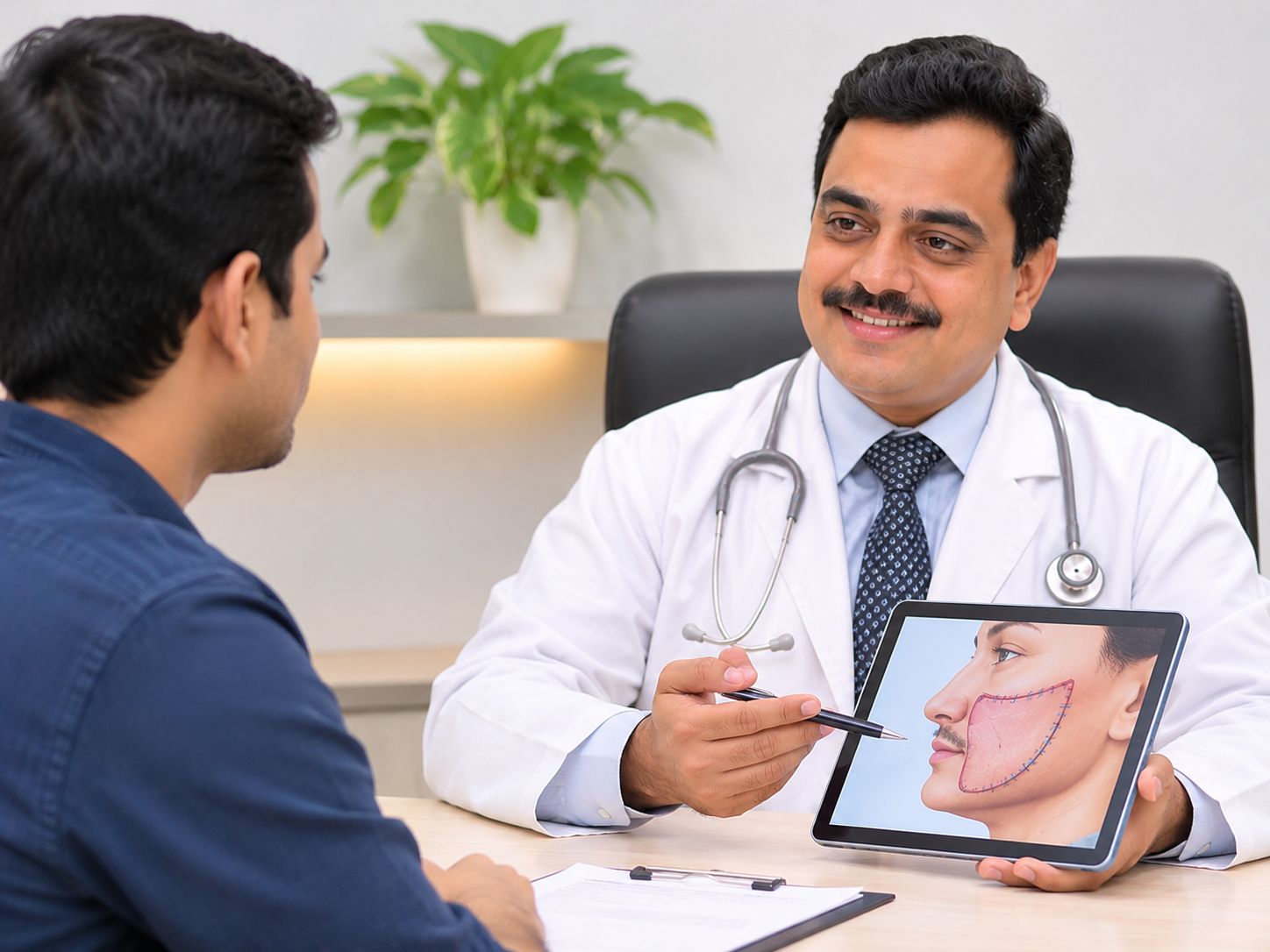
Flap surgery helps reconstruct areas affected by injury, burns, tissue loss, or previous operations by transferring healthy tissue while preserving or reconnecting its blood supply. Patients usually begin with a consultation, undergo necessary investigations, and receive an individual treatment plan. Recovery and follow-up requirements depend on the flap technique and surgical complexity.
Flap reconstruction is an important part of plastic and reconstructive surgery. It can help cover exposed structures, restore damaged tissue and improve function or appearance when simpler wound closure is unsuitable.
At Elegance Clinic, Dr. Ashutosh Shah evaluates reconstructive concerns and discusses treatment options based on each patient's condition.
What Is Flap Surgery and Who Is It For?
Flap surgery is a reconstructive procedure in which healthy tissue is moved from one area to another to repair a defect.
The transferred tissue may contain skin, fat, fascia or muscle, depending on the reconstruction required.
Unlike a conventional skin graft, a flap retains its own blood supply or has blood vessels surgically reconnected at the recipient site.
This makes flap reconstruction useful for selected wounds where ordinary skin grafting may not provide sufficient coverage.
Common reasons for flap surgery
1. Tissue loss after an injury
Severe injuries can damage skin and deeper structures. A flap may be used to cover exposed tendons, bones or other tissues when necessary.
2. Burn-related reconstruction
Burn injuries can cause tissue loss or tight scars that restrict movement. Selected patients may benefit from flap reconstruction after assessment.
3. Reconstruction following tumour removal
Removal of a tumour may leave a tissue defect that requires reconstruction to restore coverage, contour or function.
4. Non-healing wounds
Some complex wounds require healthy tissue coverage after infection control, wound preparation and appropriate medical treatment.
5. Facial reconstruction
Flap procedures may help restore tissue after injuries or surgical removal.
For example, an Abbe flap is a specialised technique used for selected lip defects.
Types of flap reconstruction
Flaps are commonly classified according to how tissue is moved and how its blood supply is maintained.
Local flaps: Tissue is transferred from an area close to the defect.
Regional flaps: Tissue is moved from a nearby anatomical region while maintaining its vascular connection.
Free flaps: Tissue is completely detached and transferred to another location, where its blood vessels are reconnected using microsurgical techniques.
Not every patient requires a free flap. The surgeon selects the approach according to the defect, blood supply and reconstructive goals.
How Flap Surgery in Pal Surat Is Done, Step by Step
Flap reconstruction requires careful planning because the transferred tissue must receive adequate blood flow to survive.
The procedure differs depending on whether a local, regional or free flap is selected.
Step 1: Initial consultation
Dr. Ashutosh Shah assesses the affected area, previous treatment and overall health.
The examination may include wound size, depth, surrounding tissue condition, circulation, sensation and functional limitations.
Patients should explain their symptoms, previous operations and any concerns about recovery.
Step 2: Investigations and medical assessment
Depending on the condition, the surgeon may recommend blood tests, imaging or vascular investigations.
Patients with diabetes, smoking-related risks, circulation problems or other medical conditions may require additional assessment.
The aim is to identify factors that could interfere with wound healing or flap survival.
Step 3: Selecting the flap technique
The surgeon determines which tissue can safely reconstruct the defect.
For selected lip reconstruction cases, specialised techniques include the Bernard flap and Estlander flap.
These procedures are not interchangeable. Each has particular indications based on the location and extent of tissue loss.
Step 4: Anaesthesia
The type of anaesthesia depends on the procedure's complexity, location and expected duration.
Small local flaps may sometimes be performed under local anaesthesia, while more extensive reconstruction commonly requires general anaesthesia.
Step 5: Flap transfer and reconstruction
The surgeon prepares the affected area and transfers the selected tissue.
For local or regional flaps, the tissue is repositioned while maintaining its blood supply.
For free flaps, microsurgical techniques are used to reconnect blood vessels.
The reconstructed tissue is then secured, and the donor area is closed or treated as required.
Step 6: Postoperative monitoring
After surgery, the team monitors the flap for adequate circulation.
Depending on the procedure, monitoring may include checking colour, temperature, swelling and blood flow.
Free flap reconstruction generally requires particularly close early observation because blood-vessel complications can threaten tissue survival.
Step 7: Discharge and follow-up
Patients receive instructions about wound care, medicines, activity restrictions and follow-up appointments.
Some procedures require additional dressings, rehabilitation or staged reconstruction.
Recovery: What the First Weeks Look Like
Recovery after flap surgery depends on the type of reconstruction, the patient's general health and whether complications occur.
A small local flap may heal differently from a complex free flap requiring microsurgery.
General recovery stages
| Recovery stage | What patients may expect |
|---|---|
| First 24–72 hours | Pain management, wound observation and flap circulation monitoring |
| First week | Dressing care, swelling management and assessment of healing |
| Second week | Continued wound checks and review of sutures or dressings when appropriate |
| Weeks 3–4 | Gradual activity progression if healing is satisfactory |
| Weeks 5–6 | Continued rehabilitation or functional recovery where appropriate |
| Following months | Scar maturation, functional improvement and possible additional treatment |
What should you avoid during recovery?
Patients should follow the surgeon's instructions regarding pressure, movement, wound care and activity.
Depending on the flap location, the team may advise avoiding:
-
Pressure directly over the reconstructed area.
-
Smoking or nicotine exposure.
-
Heavy lifting or strenuous exercise.
-
Tight clothing that restricts circulation.
-
Unapproved creams or home remedies.
-
Missing scheduled wound checks.
How important is blood circulation?
Adequate blood flow is essential for flap survival.
A sudden change in flap colour, temperature or swelling can indicate a circulation problem.
Patients should seek urgent assessment if they notice severe colour changes, increasing pain or other warning signs identified by the surgical team.
When will scars improve?
Scars generally change over several months as healing progresses.
Their final appearance depends on wound tension, skin characteristics, infection, surgical technique and individual healing.
Complete scar disappearance cannot be guaranteed.
Which Factors Change the Cost?
The cost of flap surgery varies considerably because reconstructive procedures differ in complexity and resource requirements.
A reliable estimate requires examination and a clear treatment plan.
1. Type of flap
A small local flap usually has different requirements from a complex microsurgical free flap.
2. Size and location of the defect
Large defects or areas involving important structures may require more extensive reconstruction.
3. Anaesthesia and operating time
Complex procedures may involve longer operating times, specialist equipment and additional monitoring.
4. Hospital stay
The length of admission depends on the operation and the need for postoperative observation.
5. Investigations and wound preparation
Some patients require imaging, infection management, debridement or other treatment before reconstruction.
6. Follow-up and rehabilitation
Dressings, medicines, physiotherapy and additional procedures may affect the overall cost.
Flap surgery cost checklist
| Expense | What to confirm |
|---|---|
| Surgeon fees | Is the complete planned reconstruction included? |
| Anaesthesia | What type is required? |
| Operating theatre | Are theatre and equipment charges included? |
| Hospital stay | How many days are included? |
| Investigations | Which tests are charged separately? |
| Medicines | Are discharge medicines included? |
| Dressings | Will additional wound-care visits be required? |
| Rehabilitation | Is physiotherapy necessary? |
| Follow-ups | Which consultations are included? |
The final quotation should explain what is included and which additional expenses may arise.
Insurance eligibility depends on the medical indication, policy terms and authorisation requirements.
Reaching the Clinic From Pal
Patients planning flap surgery should begin by contacting Elegance Clinic for a consultation.
During the first appointment, the surgeon assesses the defect and discusses whether flap reconstruction is appropriate.
Documents to bring
Patients should carry:
-
Previous medical reports.
-
Relevant imaging results.
-
Earlier surgical records.
-
Current medicine details.
-
Wound treatment history.
-
Information about diabetes or other health conditions.
-
Insurance documents, if applicable.
Can you send reports before visiting?
Patients may ask the clinic whether reports or photographs can be reviewed before an in-person appointment.
Remote review may help with preliminary planning, but it cannot replace a physical examination when tissue condition and blood circulation must be assessed.
Planning the procedure date
If surgery is elective, the clinic may schedule investigations, anaesthesia assessment and admission before treatment.
Patients should arrange suitable transport and assistance during recovery.
Planning follow-up appointments
Follow-up visits are especially important after flap reconstruction.
The surgical team may need to assess wound healing, blood supply, dressings and functional recovery.
Patients should confirm the follow-up schedule before travelling home.
If a wound is rapidly worsening, heavily infected or associated with severe injury, seek urgent medical care rather than waiting for a routine consultation.
Questions to Ask Before You Decide
Flap surgery can provide important reconstructive benefits, but it also involves risks that should be understood before treatment.
Questions about the procedure
-
Why is flap reconstruction recommended?
-
Are skin grafting or other treatments suitable alternatives?
-
Which flap technique will be used?
-
Where will the donor tissue come from?
-
Will microsurgery be necessary?
-
What type of anaesthesia is planned?
Questions about recovery
-
How long might hospital monitoring be required?
-
How should the reconstructed area be protected?
-
When can normal activities resume?
-
Will physiotherapy be necessary?
Questions about risks and outcomes
-
What is the risk of partial or complete flap failure?
-
Could infection or poor circulation affect healing?
-
Will there be scars at the donor and recipient sites?
-
Could additional surgery be necessary?
-
What functional improvement is realistically expected?
Possible complications
Flap surgery carries risks including bleeding, infection, wound separation, donor-site problems, altered sensation and partial or complete flap loss.
More complex procedures may also involve anaesthesia-related complications and the possibility of further surgery.
A personalised consultation helps patients understand which risks are most relevant to their condition.
Conclusion
Flap surgery is an important reconstructive option for selected patients with tissue loss, complex wounds or functional defects.
The most suitable procedure depends on the affected area, blood supply, overall health and reconstructive goals.
Dr. Ashutosh Shah at Elegance Clinic can assess the condition and explain available treatment options, recovery requirements and cost considerations.
Have questions about your situation? Book a consultation (Monday to Saturday) or contact the clinic to ask about sharing reports through WhatsApp.